
U.S.-Iran ceasefire tested by Strait of Hormuz chokehold
Clip: 4/8/2026 | 6m 23sVideo has Closed Captions
U.S.-Iran ceasefire tested by Strait of Hormuz tension and Israel’s war in Lebanon
For the first time in more than five weeks, the U.S. did not launch widespread attacks on Iran, and Iran did not strike American targets. Even as the ceasefire between the two nations largely holds, it's being tested by what appears to be Iran’s ongoing chokehold of the Strait of Hormuz, as well as Israel’s war in Lebanon. Nick Schifrin reports.
Problems playing video? | Closed Captioning Feedback
Problems playing video? | Closed Captioning Feedback
Major corporate funding for the PBS News Hour is provided by BDO, BNSF, Consumer Cellular, American Cruise Lines, and Raymond James. Funding for the PBS NewsHour Weekend is provided by...
U.S.-Iran ceasefire tested by Strait of Hormuz chokehold
Clip: 4/8/2026 | 6m 23sVideo has Closed Captions
For the first time in more than five weeks, the U.S. did not launch widespread attacks on Iran, and Iran did not strike American targets. Even as the ceasefire between the two nations largely holds, it's being tested by what appears to be Iran’s ongoing chokehold of the Strait of Hormuz, as well as Israel’s war in Lebanon. Nick Schifrin reports.
Problems playing video? | Closed Captioning Feedback
How to Watch PBS News Hour
PBS News Hour is available to stream on pbs.org and the free PBS App, available on iPhone, Apple TV, Android TV, Android smartphones, Amazon Fire TV, Amazon Fire Tablet, Roku, Samsung Smart TV, and Vizio.
Providing Support for PBS.org
Learn Moreabout PBS online sponsorshipGEOFF BENNETT: Welcome to the "News Hour."
For the first time in more than five weeks, the U.S.
did not launch widespread attacks on Iran today and Iran did not strike U.S.
targets.
Even as the cease-fire between the two nations largely held, it's being tested by what appears to be Iran's ongoing choke hold of the Strait of Hormuz, as well as Israel's war in Lebanon.
Nick Schifrin reports on the many factors that could determine if the temporary truce can become a long-term peace.
NICK SCHIFRIN: Today, in two capitals, two declarations of victory.
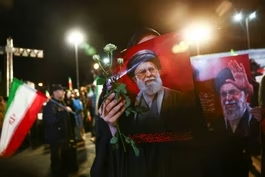
In Tehran, immediately after the cease-fire, government supporters filled the streets, desecrating what the regime has for decades called the big and little Satan.
Meanwhile, at the White House... KAROLINE LEAVITT, White House Press Secretary: This is a victory for the United States of America.
NICK SCHIFRIN: ... and the Pentagon... PETE HEGSETH, U.S.
Defense Secretary: Operation Epic Fury was a historic and overwhelming victory on the battlefield, a capital-V military victory.
NICK SCHIFRIN: ... the U.S.
declared its own goals met.
But this is what the vice president admitted was a fragile truce.
In the hours after the cease-fire, Iran attacked Israel, intercepted by air defense, and Iran reported an attack on an oil refinery in the Strait of Hormuz.
And it's that energy choke point through which 20 percent of the world's oil and natural gas usually flows that became one of the cease-fire deal's linchpins.
Today, Iranian state media announced it was closed because of ongoing Israeli attacks on Lebanon.
KAROLINE LEAVITT: This is a case of what they're saying publicly is different privately.
We have seen an uptick of traffic in the strait today.
NICK SCHIFRIN: But at the White House today, spokesperson Karoline Leavitt insisted the strait was open.
KAROLINE LEAVITT: I will reiterate the president's expectation and demand that the Strait of Hormuz is reopened immediately, quickly and safely.
That is his expectation.
It has been relayed to him privately that that is what's taking place and these reports publicly are false.
MAN: Transiting in the Strait of Hormuz is closed.
NICK SCHIFRIN: In the Persian Gulf, Iran's navy tells a different story, broadcasting this audio message today.
MAN: If any vessel tries to transit without permission will be destroyed.
Out.
NICK SCHIFRIN: And maritime intelligence organizations tell "PBS News Hour" that Iran only allowed five ships through the strait today, the same number as the day before the cease-fire.
Iranian Foreign Minister Abbas Araghchi warned -- quote -- "The cease-fire terms are clear and explicit.
The U.S.
must choose, cease-fire or continued war via Israel.
It cannot have both.
The world sees the massacres in Lebanon.
The ball is in the U.S.
court."
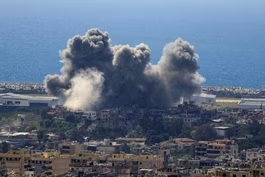
Israel today hit Lebanon with what it called the largest coordinated wave of strikes since the war in Iran began, pounding Beirut, attacking more than 100 targets within 10 minutes, and targeting Southern Lebanon, where Israeli troops recently invaded and pushed out most of the population.
Israeli Prime Minister Benjamin Netanyahu said today, this part of the war will not end.
BENJAMIN NETANYAHU, Israeli Prime Minister (through translator): I insisted that the temporary cease-fire with Iran would not include Hezbollah, and we continue to strike it hard.
J.D.
VANCE, Vice President of the United States: I think this comes from a legitimate misunderstanding.
I think the Iranians thought that the cease-fire included Lebanon, and it just didn't.
NICK SCHIFRIN: But Vice President Vance today, at the end of a trip to Budapest, Hungary, said Israel never promised to cease-fire in Lebanon, but might be willing now.
J.D.
VANCE: The Israelis, as I understand it -- again, I'm supposed to get a fuller report when I get on the plane -- have actually offered to be -- frankly, to check themselves a little bit in Lebanon because they want to make sure that our negotiation is successful.
NICK SCHIFRIN: Vance will lead negotiations with Iran beginning this weekend in Pakistan, alongside Steve Witkoff and Jared Kushner, dispatched by President Trump.
J.D.
VANCE: He's told us to come to the negotiating table.
But if the Iranians don't do the exact same thing, they're going to find out that the president of the United States is not one to mess around.
He's impatient.
He's impatient to make progress.
He has told us to negotiate in good faith.
NICK SCHIFRIN: Last night, Iran's supreme National Security Council released its negotiating demands, including -- quote - - "the establishment of a secure transit protocol in the Strait of Hormuz in such a manner as to guarantee Iran's dominion, withdraw of U.S.
forces from the Middle East, and U.S.-Israeli reparations."
The U.S.
has long rejected those demands.
Iran is also demanding the lifting of all sanctions, which President Trump acknowledged today was on the table.
But, in turn, Iran has rejected the U.S.'
longstanding demands, including no domestic uranium enrichment, end of support for proxies, and limits on missile inventory and range.
And, today, the U.S.
added a new demand and threat.
Iran must hand over its nearly 1,000 pounds of highly enriched uranium, believed buried under the rubble of last summer's U.S.
strikes, or the U.S.
will launch a raid to seize it.
PETE HEGSETH: They will either give it to us, which the president the president is laid out.
They will give it to us voluntarily.
We will get it.
We will take it.
We will take it out.
NICK SCHIFRIN: But back in Tehran, there is cautious relief and, for some, a clear enemy.
MAN (through translator): Everyone likes peace and calm, but, unfortunately, someone is talking to us who is not trustworthy at all.
DONALD TRUMP, President of the United States: Every bridge in Iran will be decimated by 12:00 tomorrow night.
NICK SCHIFRIN: Even for President Trump, it has been a volatile 48 hours.
He whipsawed between threatening to destroy Iran's civilization unless there was a deal to an 11th hour deal, declaring the cease-fire and claiming "Almost all of our various points of past contention have been agreed to."
For European allies confronting an unpredictable president, for the U.S.'
Gulf allies facing persistent new Iranian threats, and for energy infrastructure that will take months or years to rebuild, the war will have consequences long beyond any cease-fire.
Tonight, a U.S.
official acknowledges to me that the Strait of Hormuz is basically a pressure valve that Iran can turn on and off.
But the official argues the war has shifted Iran's demands, including its willingness to accept this temporary cease-fire.
The challenge now is this weekend's negotiations, which Iran enters with a leverage over the strait, Geoff, that it did not have before the war.
GEOFF BENNETT: Nick Schifrin, our thanks to you.
 New
NewA Brief But Spectacular take on how life is a play
Video has Closed Captions
A Brief But Spectacular take on how life is a play (3m 14s)
 New
NewFormer U.S. officials on chances Iran ceasefire can hold
Video has Closed Captions
Former U.S. officials analyze chances fragile Iran ceasefire can hold (7m 29s)
 New
NewICE detains DACA recipient delivering milk to premature baby
Video has Closed Captions
DACA recipient detained by ICE while delivering milk to premature daughter in NICU (7m 10s)
 New
NewIsrael strikes Lebanon without warning, more than 200 dead
Video has Closed Captions
Israel strikes Lebanon without warning, hours after Iran ceasefire announced (4m 54s)
 New
NewNews Wrap: NATO chief meets with Trump amid tensions
Video has Closed Captions
News Wrap: NATO chief meets with Trump in bid to ease tensions (5m 26s)
 New
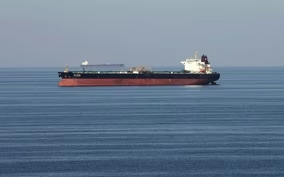
NewOil infrastructure recovery will take months, expert warns
Video has Closed Captions
Expert warns Middle East energy infrastructure will take months to recover (6m 41s)
 New
NewPortland's $1.6B climate fund sparks spending debate
Video has Closed Captions
America’s first billion-dollar climate fund sparks spending debate in Portland (8m)
 New
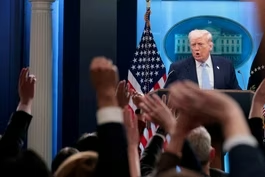
NewTrump says Israeli strikes on Lebanon a 'separate skirmish'
Video has Closed Captions
Trump says Israeli strikes on Lebanon a 'separate skirmish' not part of Iran ceasefire (2m 58s)
Providing Support for PBS.org
Learn Moreabout PBS online sponsorship
- News and Public Affairs

FRONTLINE is investigative journalism that questions, explains and changes our world.

- News and Public Affairs

Amanpour and Company features conversations with leaders and decision makers.












Support for PBS provided by:
Major corporate funding for the PBS News Hour is provided by BDO, BNSF, Consumer Cellular, American Cruise Lines, and Raymond James. Funding for the PBS NewsHour Weekend is provided by...