
March 17, 2026 - PBS News Hour full episode
3/17/2026 | 57m 46sVideo has Closed Captions
March 17, 2026 - PBS News Hour full episode
March 17, 2026 - PBS News Hour full episode
Problems playing video? | Closed Captioning Feedback
Problems playing video? | Closed Captioning Feedback
Major corporate funding for the PBS News Hour is provided by BDO, BNSF, Consumer Cellular, American Cruise Lines, and Raymond James. Funding for the PBS NewsHour Weekend is provided by...
March 17, 2026 - PBS News Hour full episode
3/17/2026 | 57m 46sVideo has Closed Captions
March 17, 2026 - PBS News Hour full episode
Problems playing video? | Closed Captioning Feedback
How to Watch PBS News Hour
PBS News Hour is available to stream on pbs.org and the free PBS App, available on iPhone, Apple TV, Android TV, Android smartphones, Amazon Fire TV, Amazon Fire Tablet, Roku, Samsung Smart TV, and Vizio.
Providing Support for PBS.org
Learn Moreabout PBS online sponsorshipAMNA NAWAZ: Good evening.
I'm Amna Nawaz.
GEOFF BENNETT: And I'm Geoff Bennett.
On the "News Hour" tonight: Israeli strikes kill Iran's security chief and another high-level official in a major blow to that country's leadership.
AMNA NAWAZ: The head of the U.S.
National Counterterrorism Center resigns in protest over the war in Iran, saying the country posed no imminent threat.
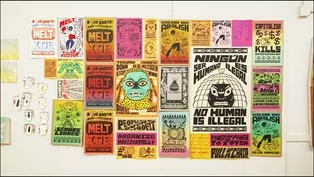
GEOFF BENNETT: And a group of Chicago artists is channeling their skills into organizing and protests amid the federal immigration crackdown.
JOSE OCHOA, President, National Museum of Mexican Art: Am I completely surprised?
No.
In communities of color and in disenfranchised communities, we're always waiting for the shoe to drop.
And it's always going to drop on us first.
(BREAK) GEOFF BENNETT: Welcome to the "News Hour."
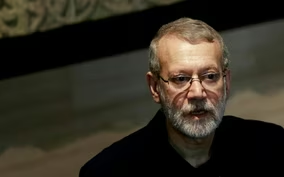
Iranian officials confirmed today that Ali Larijani was killed by an Israeli airstrike that also killed a second top security official.
Larijani had been a fixture of Iran's regime for decades and had essentially led Iran since the killing of its supreme leader at the start of the war.
AMNA NAWAZ: Also today, for the first time in years, a senior U.S.
government official resigned in protest.
Joe Kent directed the National Counterterrorism Center and today refuted President Trump's statements that Iran presented an imminent threat.
Kent said the war was in Israel's interest, but not the United States'.
Nick Schifrin starts us off looking at both of those stories, beginning with Israel's strikes on the regime in Tehran.
NICK SCHIFRIN: In Tehran today, an Israeli assault to decapitate the Iranian state.
Ali Larijani was the country's top national security official.
And analysts believed he was largely running the country since the death of Ayatollah Ali Khamenei.
Larijani was responsible for the ayatollah's succession plan, oversaw the recent nuclear negotiations with the U.S., was the main conduit for decades for Iran's allies China and Russia.
And during January protests that challenged the theocracy's 47-year-old rule, he oversaw the crackdown that left tens of thousands dead.
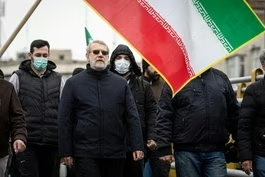
At his last public appearance at this pro-government protest, he was, to the end, defiant.
ALI LARIJANI, Iranian Security Chief (through translator): Trump's problem is that he does not have the wisdom to realize that Iranian people are brave.
They are a strong nation and a determined nation.
DONALD TRUMP, President of the United States: He was in charge of the killing of protesters.
It's an evil group.
NICK SCHIFRIN: In Washington, President Trump praised Israel's strike on Larijani and these follow-on Israeli strikes today that Iran confirmed killed Gholam Reza Soleimani, the head of the Islamic Revolutionary Guard Corps' Basij Militia, responsible for domestic security, including the January crackdown.
Israeli Prime Minister Benjamin Netanyahu called the strikes a path to regime change.
BENJAMIN NETANYAHU, Israeli Prime Minister (through translator): We are undermining this regime in the hope of giving the Iranian people an opportunity to remove it.
NICK SCHIFRIN: Netanyahu also suggested that Israeli jets will soon help defend the U.S.
's Gulf allies from Iranian attacks.
BENJAMIN NETANYAHU (through translator): With God's help, we have reached a situation where, after October 7, when we were on the brink of collapse, we are now a mighty power, almost global, together with our ally, who is the global superpower, fighting shoulder to shoulder.
DONALD TRUMP: Israel has been our partner.
Israel has been very, very strong.
NICK SCHIFRIN: It is that very American-Israeli collaboration... MIKE HUCKABEE, U.S.
Ambassador to Israel: The president asked me to come and make sure you were OK.
NICK SCHIFRIN: ... celebrated today in a social media video of Netanyahu with American Ambassador Mike Huckabee and crescendoing in this joint U.S.-Israeli war in Iran that came under attack today by National Counterterrorist Center Director Joe Kent.
He publicly resigned in protest, writing to President Trump directly, saying -- quote -- "Early in this administration, high-ranking Israeli officials and influential members of the American media deployed a misinformation campaign that wholly undermined your America first platform and sowed pro-war sentiments to encourage a war with Iran.
This echo chamber was used to deceive you into believing that Iran posed an imminent threat to the United States, and that, should you strike now, there was a clear path to a swift victory.
This was a lie."
Multiple former officials tell PBS NewsHour that Kent's criticism is echoed by other members of the administration.
Kent is an Army veteran who deployed 11 times and whose wife was killed by ISIS in Syria.
He is also a politician who twice ran and lost congressional races in Washington state.
DONALD TRUMP: When I read his statement, I realized that it's a good thing that he's out, because he said that Iran was not a threat?
Iran was a threat.
Every country realized what a threat Iran was.
The question is whether or not they wanted to do something about it.
NICK SCHIFRIN: Today, Iran and its proxies continued to prove their ongoing threat.
Rockets and drones targeted the U.S.
Embassy in Baghdad, while, in Central Israel, a cluster warhead fired by Iran spewed shrapnel into a parking lot and train station.
Israel maintained its own pressure today on Lebanon, pounding Southern Beirut, where Hezbollah operates.
Since these strikes began, Lebanon's Health Ministry said today 900 have been killed.
This regional war continues to rage and spark political battles in the U.S.
For the PBS "News Hour," I'm Nick Schifrin.
GEOFF BENNETT: We turn now to our White House correspondent, Liz Landers, for more on the political context to all of this.
All right, Liz, so tell us more about Joe Kent, the director of the National Counterterrorism Center, who resigned today in protest.
LIZ LANDERS: Yes.
Well, with his background as a Green Beret and a former CIA official, he has both this military and intelligence background, but he really represents sort of the MAGA portion of this administration who is anti-war.
And that is what we saw today in these comments from him.
He has a close relationship with Tucker Carlson, who we've mentioned previously has been critical of this war in Iran since it started.
He's also a close ally of Tulsi Gabbard, the director of national intelligence.
She herself has been quite anti-war in the past.
When she ran as a Democratic candidate in 2020, she ran really on that platform, no more foreign wars and interventions.
I remember seeing him at her confirmation hearings last year on Capitol Hill as a close friend of hers.
She responded today, it seemed, to his comments that Iran posed no imminent threats.
And these are the first comments that we've seen from her about the war since it started.
She said: "President Trump concluded that the terrorist Islamist regime in Iran posed an imminent threat, and he took action based on that conclusion."
Geoff, she testifies tomorrow on Capitol Hill.
I am sure that she will be asked about both Kent's resignation and also these comments about Iran.
GEOFF BENNETT: Yes.
Kent, we should note, had some extremist associations?
Tell us more about that.
LIZ LANDERS: During the confirmation hearings on Capitol Hill last year, both the ADL, the Anti-Defamation League, and the Southern Poverty Law Center were urging members of Congress not to confirm him because of these extremist links of his in the past.
Today, we heard from Congressman Don Bacon online, who quipped "Good riddance" and accused Kent of antisemitism.
The Anti-Defamation League said again today that Kent has a -- quote - - "history of antisemitism and extremism, so it's no surprise that he would blame Israel and the media" in that resignation letter.
The Associated Press has covered some of Kent's extremism links in the past.
He has held calls.
He held a call with Nick Fuentes, who is a Holocaust denier.
He later denounced Fuentes, but that's just one example of a very extreme figure that he has links to from the past.
GEOFF BENNETT: Liz Landers, thank you for that reporting.
We appreciate it.
AMNA NAWAZ: All right, let's get another take on National Counterterrorism Director Joe Kent's resignation.
GEOFF BENNETT: And, for that, we hand it back over to Nick Schifrin.
NICK SCHIFRIN: To discuss Kent's comments about Iran and what his resignation says about the intelligence community, I'm joined by Nick Rasmussen, who under the Obama administration directed the National Counterterrorism Center, the same center from which Kent resigned today.
Nick Rasmussen, thanks very much.
Welcome back... NICHOLAS RASMUSSEN, Former Director, National Counterterrorism Center: Thank you.
NICK SCHIFRIN: ... to the "News Hour."
In the letter, Kent refutes the president and says Iran was not an imminent threat.
What do we know about what Kent might have seen in the intelligence that would lead him to so publicly go against the president?
NICHOLAS RASMUSSEN: Well, the question of imminence when you're talking about threats, national security threats, is not a black-and-white matter, as you can imagine.
And even in what Director Kent put on the record with his letter today, he didn't speak specifically to the nuclear threat or the threat to U.S.
interests from terrorism or the threat from, for example, Iran's ballistic missile program.
So in a sense, we don't know exactly what he was alluding to with his comments.
As I was saying a bit ago, the concept of imminence is not black and white.
It can have a very temporal component to it.
If the intelligence community, for example, were in possession of information that said or suggested that an attack on U.S.
interests was going to happen at this place on that day in this manner, that would certainly constitute an imminent threat.
But you can have imminence without having all of those elements as well.
If you feel like -- and I say feel -- if you feel like you don't have the ability to forecast and project when an attack might happen, that might create a sense of imminence, even if you don't have that specific intelligence giving you time and place.
NICK SCHIFRIN: Kent also says in the letter it's quote "a lie" that there's a clear path to victory.
We don't really know what necessarily that means, but U.S.
officials have told me that the intelligence assessment is that the Iranian regime is unlikely to fall despite this war.
Is that the kind of thing that he would be saying, that he would be talking about there?
NICHOLAS RASMUSSEN: Again, I don't really -- obviously, I have no insight into what the intelligence assessments say right now about what Iran will look like in the aftermath of this campaign.
But I will say that most national security professionals I know of on all political sides very much want to see the Iranian capability to carry out terrorist activity around the world, to act aggressively against neighbors, to threaten the West, want to see that capability degraded and diminished.
And so that is something I think on which there is pretty wide unanimity among intelligence and national security professionals.
NICK SCHIFRIN: Bottom line, the NCTC is responsible for analyzing, assessing the threat, and integrating intelligence, both foreign and domestic.
So is that mission affected by his resignation today?
NICHOLAS RASMUSSEN: I mean, I'd like to think and I have confidence that the men and women who work at NCTC are still doing exactly that work, Nick, and kind of keeping their eye on the ball.
They're very mission-focused, making sure that they have their eyes on every bit of available intelligence so that they can prepare the best possible assessments to support policymakers, up to and including the president.
At the same time, any time a leader is -- departs the scene, it can be a little bit disruptive.
And I suspect the acting director, whoever he or she, is moving to try to send signals of stability and confidence to the work force to keep them on track.
NICK SCHIFRIN: How much do we know whether the NCTC has been doing, whether Joe Kent has been doing, that role that we traditionally believe the NCTC has done, including under you?
NICHOLAS RASMUSSEN: Well, the organization has certainly been preparing, I would believe, the intelligence assessments to undergird and to support good policymaking and good decision-making.
As ever, it's a question of how those assessments are landing with the customer set.
NICK SCHIFRIN: Right, the customer, of course -- the ultimate, of the I.C., customer is the president of the United States.
NICHOLAS RASMUSSEN: Exactly.
NICK SCHIFRIN: Right.
NICHOLAS RASMUSSEN: But I don't want to understate how important it is that that work go on even to support those beyond the president.
For example, when you're thinking about the homegrown violent extremist threat here in the United States, it's just as important, I would argue, that NCTC, along with FBI, the Department of Homeland Security and CIA and our other intel community partners, support the state and local apparatus around the country as they try to worry and deal with potential homegrown threats.
So that customer set is wide, deep, and very expansive.
NICK SCHIFRIN: And -- but since the war has started, we have seen multiple homegrown attacks, some of which it does seem to be, to be inspired by the war, whether in Iran or in Lebanon with Hezbollah.
How much would the NCTC have been focused on that and how much will it be going forward?
NICHOLAS RASMUSSEN: They would certainly be focused on those kinds of attacks.
When an attack like that happens along with FBI partners and other intelligence community and law enforcement partners, they would be digging in to try to determine what motivated this individual to carry out the attacks that were undertaken.
And I would surmise we don't know the full answer to that.
We have seen some early press reporting, as you suggested, linking these attacks to what happened in Iran or what's happening in Lebanon.
But that work probably continues with FBI in the lead as an investigative matter.
NICK SCHIFRIN: And just quickly, in the last few seconds we have, overall, zoom out for us.
Where is the overall counterterrorism effort for the United States today?
NICHOLAS RASMUSSEN: I mean, I worry a bit.
But, again, I'm used to worrying in this sense.
You always worry when you come from a background where you focus on terrorism and counterterrorism.
But I worry a little bit about the hollowing out of a work force that has gotten younger and less experienced over time with departures from government service, either voluntary or involuntary, downsizing, budget cuts, budget reductions, the shift in emphasis away from counterterrorism and terrorism towards state competition, state conflict, and other administration priorities, to include immigration.
NICK SCHIFRIN: Nick Rasmussen, thank you very much.
Amna, back to you.
AMNA NAWAZ: And we return now to the Israeli killing of one of Iran's most senior leaders, Ali Larijani, and their killing of the head of Iran's Basij internal security force.
For that, we get two views.
Alan Eyre had a four-decade career in U.S.
government, including in the Foreign Service, focusing on Iran.
He's now at the Middle East Institute.
And retired Colonel Joel Rayburn had a 26-year career in the Army.
During the first Trump administration, he was on the National Security Council staff focusing on Iran in the Middle East.
He's now a senior fellow at the Hudson Institute.
Welcome back to you both.
Alan, I will begin with you.
The killing of Ali Larijani, how significant is it?
What does it change?
ALAN EYRE, Middle East Institute: It's pretty significant.
He was the most important civilian leader right now in Iran, alongside the head of the Parliament Speaker Ghalibaf.
So it's important, and it's quite possible he will be replaced by someone more hard-line.
But what's supposed to be important above and beyond what the individual is up, down, living, and dead are the institutions.
And here's what hasn't changed.
The Islamic Revolutionary Guard Corps and the Beit-e Rahbari, which is the administrative exoskeleton that the late Ayatollah Khamenei created.
They're still in the driver's seat.
So Larijani's dead, but his power never came from popular appeal.
He was handpicked by the elites.
They will pick someone else and Iranian policy will by and large continue in the current war footing.
AMNA NAWAZ: Joel, this idea that Larijani's killing means a more extremist replacement for him, a more hard-line replacement, and makes the regime more intractable, harder to deal with, do you agree with that?
COL.
JOEL RAYBURN (RET.
), Former Trump National Security Council Staff: Well, they're already pretty intractable.
I don't know how any -- how much more intractable they can become is marginal.
And I think Ali Larijani represented continuity from Ali Khamenei's policy, his national security policy, his hostility to the United States and the surrounding region.
He was also one of the main people, as Alan pointed out, directing the Iranian war effort.
So, I mean, he's a valid legitimate military target.
And I don't think you can worry about the personalities inside that ruling coterie when you're doing that kind of targeting.
You have to go after the enemy chain of command if you're in the position of the United States and Israel.
So that's what was done.
I think actually, though, where I would disagree with Alan somewhat is, leadership does matter.
Ali Larijani has been there in that leadership team for more than a decade.
I mean, he's had a very senior role going back multiple decades.
So there is -- institutions may be strong or they may be brittle.
There is in the Iranian regime a precedent that leadership, if it's eliminated, can lead to a drop-off.
Look at the removal of Qasem Soleimani.
The Quds Force, the Iranian Quds Force has never been the same since the taking out of Qasem Soleimani, replacing by Esmail Qaani.
There was a -- there's a degradation in their capabilities, their effectiveness and their coherence.
So, yes, institutions matter, but leadership, individual leadership matters just as much, I think.
AMNA NAWAZ: Is the regime less capable, less competent without Larijani?
Could that lead to regime change?
ALAN EYRE: Well, certainly less competent.
Joel's quite right.
There's collective expertise.
Larijani had a lot of it.
What's interesting about him, though, is, for example, he was on the outs politically as recently as 2025.
He was barred from running for president by the elites in 2021 and 2024.
So he's had an up-and-down career.
But you're quite right.
There's a degradation of function here.
Will that increase the chances of regime change?
I don't think so.
I don't think that's a logical corollary to the fact that he's been killed by the Israelis.
I think it's just more likely that this regime will continue on its war footing and sort of stumble along, and whoever replaces him might not be as competent, but will follow the same general lines.
AMNA NAWAZ: Joel, what have you seen that leads you to believe that the killing of Larijani and other senior leaders could lead to regime change, when the next person in line basically steps up to replace them each and every time?
Revolutionary Guard Corps has tens of thousands of people ready to step up and keep replacing anyone killed.
COL.
JOEL RAYBURN (RET.
): Well, if leaders are eliminated and new ones step up and they're eliminated, eventually, there's a deterrent to the leadership.
I don't think they're all suicidal.
I don't think they're all seeking martyrdom.
At some point, there's pragmatism that sets in.
And there is a pragmatic element to the Iranian regime over time.
They can be deterred over time.
I mean, the law of gravity does apply to the Iranian regime.
And it is, I think, in the process of kicking in as their military capabilities are getting close to nil.
AMNA NAWAZ: When you look at their military capabilities, Alan, the way they are still fighting this war, you have talked about Iran having a sort of mosaic defense.
Explain that to us and why it's working for them.
ALAN EYRE: Well, it's not how else well it's working.
They're still getting pummeled by the U.S.
and Israel.
But the mosaic doctrine was born of long experience.
It started after the Iran-Iraq War.
And it's basically decentralizing command-and-control to much lower-levels, so if you decapitate the leadership, you can still have lower-levels acting on their own autonomously, perhaps with prearranged or prewritten orders.
And that's what's working for Iran right now.
So Israel is pursuing a decapitation strategy.
But all that's done, and it's significant, in addition to degrading sort of the collective expertise, is pushing decisions down and out.
AMNA NAWAZ: So if the plan is to operate in this decentralized way, what does that mean for how the U.S.
and Israel wage this war?
And does it stretch the timeline, I mean, that an unpopular war here in the U.S.
that's causing oil prices to go up could stretch even longer?
COL.
JOEL RAYBURN (RET.
): Well, I don't think you can mount a coherent strategic defense when your decentralized elements can't cross-coordinate, they can't mount a synchronized defense, synchronized operations, and their capabilities are distributed.
You just wind up with a bunch of, over time -- you may in the first few volleys have a significant response.
That petered out after the first couple of days.
And now there are essentially isolated elements that can't communicate with one another.
If they're pressured in one place, they can't come to one another's assistance and so on.
I mean, in an operational sense, a strategic sense, the Iranian regime is essentially defenseless right now.
AMNA NAWAZ: In the few seconds I have left, if the regime does collapse, Alan, what takes its place?
Is the U.S.
better off with whatever replaces it?
ALAN EYRE: Well, if it collapses, you have a collapsed state, you have a failed state.
The law of entropy works one way.
You don't collapse into something as complex or more complex.
So a failed state doesn't lead to a new, different, better, more pro-Western, more user-friendly regime.
It leads to a failed state.
And we have seen in the Middle East lots of examples of failed states and what happens.
AMNA NAWAZ: I will give you the final word here, Joel.
Your response?
COL.
JOEL RAYBURN (RET.
): Well, you can have a failed state Iran that is not a threat to the surrounding region, or you can have a kind of Iran that Ali Khamenei built, which was quasi-thriving, using its resources to pose a threat to the region and international security.
AMNA NAWAZ: Colonel Joel Rayburn, Alan Eyre, great to see you both.
Thank you.
ALAN EYRE: Thank you.
GEOFF BENNETT: In the day's other headlines: The weather whiplash shows no signs of letting up, with travelers caught in the middle.
JIM MARCOTTE, Air Traveler: Look at this line.
It's long.
I hope I don't miss my flight.
GEOFF BENNETT: The wild weather has played a part in the more than 7,000 delays across the country.
The airport upheaval has been compounded by the DHS shutdown, which has led to widespread TSA staffing shortages.
A top TSA official said today that some smaller airports may have to shut down if agency funding remains cut off.
It comes after powerful storms swept through the eastern half of the country, toppling trees and power lines overnight in parts of New England, while, in the Upper Midwest, people are still digging out from feet of snow that fell over the weekend.
In Cuba, utility providers are slowly restoring power after the island's latest blackout.
That's as Trump administration officials call for new leadership.
The Caribbean nation suffered its third countrywide blackout in just the last four months, which officials largely blame on the ongoing U.S.
oil blockade.
In that Oval Office meeting earlier today with Ireland's delegation, Secretary of State Marco Rubio stressed that Cuba's leaders are incapable of addressing its problems.
MARCO RUBIO, U.S.
Secretary of State: They're in a lot of trouble.
And the people in charge right -- they don't know how to fix it.
So they have to get new people in charge.
GEOFF BENNETT: Just yesterday, President Trump said he could have the honor of taking Cuba in some form, adding -- quote -- "I can do anything I want with the nation."
It follows Cuba's president saying talks have started between U.S.
and Cuban officials with the aim of ending the crisis.
In Afghanistan, officials say at least 400 people were killed in an airstrike overnight by Pakistan.
Workers pulled bodies from the wreckage of a drug rehabilitation hospital in Kabul today, and the Taliban-led government-threatened retaliation.
Pakistan did claim responsibility for the strike, but said it had targeted a military facility.
And it dismissed Afghanistan's claims that hundreds were killed as propaganda.
Survivors filled nearby hospitals, where they described the chaotic moments of the attack.
HASSAN, Kabul Strike Survivor (through translator): I was in the kitchen cooking food for the patients, when suddenly I heard the sound of an aircraft, and the kitchen filled with fire.
I rushed outside and saw that everything was on fire.
The flames were coming from above.
GEOFF BENNETT: The U.N.
has called for an investigation of the strike.
It marks a dramatic escalation in tensions between the two countries following weeks of cross-border attacks.
Back in this country, residents in Northeast Ohio reported a loud boom this morning as a suspected meteor fell from the sky.
The National Weather Service put out this video of the fireball streaking across the horizon.
You see it there.
It could be seen hundreds of miles away, with the American Meteor Society saying it received reports from Wisconsin to Maryland.
An astronomer with that organization said it was likely the size of a softball or a basketball, though an expert at NASA put it at nearly six feet across.
And, of course, today is St.
Patrick's Day, which brought celebrations of Irish heritage across the country.
As usual, New York City hosted the world's oldest and largest St.
Patrick's Day Parade with roots dating back to the 1760s.
Thousands braved the cold to watch marching bands, veterans groups and community organizations march up Fifth Avenue, with many dressed in their festive green.
Meantime, on Capitol Hill today: REP.
MIKE JOHNSON (R-LA): In many ways, the story of America cannot be told without the story of the Irish.
We are intertwined in that way.
GEOFF BENNETT: House Speaker Mike Johnson joined President Trump and Ireland's leader, Micheal Martin, for a Friends of Ireland luncheon, while in Boston, former President Joe Biden, who often speaks about his Irish roots, made an unannounced stop at a St.
Patrick's Day breakfast, where he commended Ireland's commitment to democratic values.
On Wall Street today, stocks held steady despite another rise in oil prices.
The Dow Jones industrial average managed a slight gain of nearly 50 points.
The Nasdaq added roughly 100 points on the day.
The S&P 500 also ended slightly higher.
And Kiki Shepard, longtime co-host of "Showtime at the Apollo," has died.
MAN: All right, we're going to have to love the Kiki Shepard.
All right.
(CHEERING) MAN: Woo!
Look at that.
Woo!
Looking like Ms.
Jackson, huh?
GEOFF BENNETT: Dubbed the Apollo Queen of Fashion, Shepard was a staple on the show, appearing from 1987 to 2002.
She also appeared on a range of TV shows, including "A Different World" and "Grey's Anatomy."
And Shepard was a devoted advocate for patients and families of those affected by sickle cell disease.
Her representative said she died of a heart attack.
Kiki Shepard was 74 years old.
Still to come on the "News Hour": how the closure of the Strait of Hormuz is causing massive trade disruptions worldwide; we examine the career and qualifications of Senator Markwayne Mullin, President Trump's pick to lead the Department of Homeland Security; and Team USA faces off against Venezuela in the World Baseball Classic final.
As the war with Iran continues, businesses and shipping companies are growing increasingly concerned about potential disruptions to the global supply chain, from rising shipping costs to delayed cargo and vessels stranded at sea.
So far, major ports here in the U.S., including the Port of Los Angeles, are operating normally, with no significant congestion.
Much of that traffic moves along transpacific routes between Asia and the U.S.
but there are real questions about how long that stability can hold as tensions escalate in the Middle East and shipping routes face heightened security risks.
For more on what this could mean for global trade in the weeks ahead, we're joined again by Gene Seroka, executive director of the Port of Los Angeles.
Welcome back to the program.
GENE SEROKA, Executive Director, Port of Los Angeles: Good to see you, Geoff.
GEOFF BENNETT: So there are a number of forces hitting shipping and the global supply chain all at once right now.
Let's start with Iran.
We have heard about the threat, but when might the impact really begin to show up?
GENE SEROKA: Well, it's very interesting, because we're already seeing impacts, but how much and how far they cascade remains to be answered.
For example, we're now about 18 days into this war, and there are about 2,000 ships that normally would have crossed through and back on the Strait of Hormuz.
They're not moving right now.
The price of the ship fuel that we use on the container vessels has more than doubled in the past 2.5 weeks.
And while the transpacific trade accounts for 95 percent of our business and is moving smoothly, it's after lunar new year, where we're typically in a slower time of our season.
GEOFF BENNETT: Well, right.
You pointed out that February volumes were the second highest ever for that month, but this possible seasonal slowdown, what kind of slowdown are you expecting?
GENE SEROKA: Well, realistically speaking, last year, Geoff, we had a pretty big run-up before the tariffs.
And then, as hard policy went in, we saw the ups and downs of cargo flow.
Realistically speaking, we will probably be down about 5 percent this year with the information we have today, just based on the inventory levels across the country from the import side of the business.
GEOFF BENNETT: What about the safety of these vessels going through the Strait of Hormuz?
How much is that reshaping routes, transit times, the cost of moving goods?
GENE SEROKA: It's the focus of our entire industry when it comes to shipping and transportation, and not just containers, the energy products, bulk, agriculture, as well as fertilizers.
Realistically speaking, right now, the Middle East trade for global carriers accounts for about 10 percent of their business, yet all eyes are on this geography and situation.
We have to look at reroutes possibly for fueling of those vessels.
And what do you do with those ships with the Arabian Gulf, as well as the Red Sea, both in high-level security alerts?
Cargo ships are going around the Cape of Good Hope of Africa to get to markets in Europe and the East Coast of the U.S.
GEOFF BENNETT: There's been discussion about military escorts for vessels going through the strait.
How realistic is that?
GENE SEROKA: We're not there yet.
Executives tell me that they are not willing to risk the safety and the lives of their crew, talk about insurance and caravans to go through the strait are nowhere near where we need to be.
And there's not going to be an all-clear sign.
This is going to be progress that has to be worked on, day in and day out.
We haven't seen a real endgame here yet.
GEOFF BENNETT: Given your experience, your past experience working in the Middle East, what other flash points are you worried about when it comes to global shipping?
GENE SEROKA: Well, this goes well beyond what we had seen before, with the attacks on the fueling stations at the Dubai airport, the Fujairah port, which is on the other side of the strait.
And looking upstream in Bahrain and Kuwait, these are all concerning areas, because there's, A, a lot of consumption, and, B, the output from these areas on the energy products is very important to the world markets.
GEOFF BENNETT: In your conversations with administration officials, do you get the sense that they understand the severity here?
GENE SEROKA: Yes, I do, and there are no real clear answers.
This has been a complicated situation for decades.
And one of the concerns we have when I lived in the Middle East was that day that those strait -- that strait closed.
We have reached that, and the consequences are quite dire.
GEOFF BENNETT: What signs are you watching for most closely at the Port of Los Angeles?
GENE SEROKA: Realistically, that cargo flow.
We look at the velocity of the ships, how quickly they're unloaded, the trains and the trucks that move.
And all of those key indicators are really humming at this point, better than where we were before COVID.
Watching that price of fuel, because it will get passed on to the importers and exporters and then ultimately their customers and consumers.
But also if we start to see Asia ports get clogged up because cargo is not moving to the Middle East, that could have secondary impacts in the transpacific markets.And just think of that port congestion that we witnessed several years back.
It's not going to be to that level just yet, but if this becomes a more protracted war in the Middle East, we're going to have to make decisions from there.
GEOFF BENNETT: Gene Seroka, executive director of the Port of Los Angeles, thanks for being here.
GENE SEROKA: Thank you, Geoff.
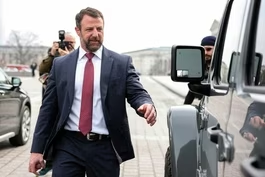
AMNA NAWAZ: Oklahoma Senator Markwayne Mullin will face his colleagues tomorrow for his confirmation hearing to lead the Department of Homeland Security.
Mullin's nomination comes after President Trump fired former DHS head Kristi Noem in the first Cabinet shakeup of his second term.
Lisa Desjardins takes a look at how Senator Mullin went from an MMA fighter to a MAGA warrior and now he might soon run DHS.
WOMAN: Yes, tonight, please put your hands together for Senator Markwayne Mullin.
(CHEERING) LISA DESJARDINS: He is unconventional, a former MMA fighter, a businessman without a bachelor's degree, and he's often unfiltered,for example, stumping for the Trump campaign in 2024 in North Carolina.
SEN.
MARKWAYNE MULLIN (R-OK), DHS Secretary Nominee: Man, I'd like to say I got a great connection to North Carolina.
I don't really.
(LAUGHTER) LISA DESJARDINS: But he is Oklahoma through and through.
SEN.
MARKWAYNE MULLIN: Hi, I'm Markwayne Mullin with Mullin Plumbing.
LISA DESJARDINS: The owner of his family's plumbing business and a cattle rancher, Mullin branded himself as a political outsider when he first ran for Oklahoma's Second Congressional District in 2011.
NARRATOR: Like you, Markwayne Mullin is had enough of Washington intruding in our lives.
LISA DESJARDINS: Mullin won, becoming the second Republican to represent the district in a century.
REESE GORMAN, NOTUS: He's from Stilwell, Oklahoma, which is a very rural part of the state.
It also is one of the poorest cities in all of the country.
LISA DESJARDINS: Reese Gorman reports on Congress for NOTUS and covered Mullin as an Oklahoma reporter, including Mullin's pledge to serve no more than three House terms.
But when the time came, Mullin and his wife, Christie, reconsidered, prayed, and: SEN.
MARKWAYNE MULLIN: We looked at each other and we said, we're running again.
And immediately we understand that people are going to be upset.
And we get that.
We understand it.
REESE GORMAN: Oklahomans were definitely upset about it, but it didn't cost him the election.
LISA DESJARDINS: Mullin won the race, and more attention followed, including from President Donald Trump.
SEN.
MARKWAYNE MULLIN: And President Trump was one of the first people to call me.
LISA DESJARDINS: Mullin said on a podcast last year that Trump phoned him weekly after his son suffered a traumatic brain injury in 2020.
Later that year, when Trump lost the presidential election, Mullin echoed lies that the vote was stolen and said he planned to contest the results.
SEN.
MARKWAYNE MULLIN: When there's as many questions still out there on the electoral votes and the votes that took place, we had to challenge it.
That's what Congress is supposed to do on January 6.
LISA DESJARDINS: Instead, rioters stormed the Capitol on January 6.
That day, Mullin helped Capitol Police block the doors to the House chamber.
WOMAN: The no's have it.
LISA DESJARDINS: Hours later, he still voted to challenge the 2020 election results and continued to defend Trump.
And, soon, Trump backed Mullin in his 2022 Senate run.
Mullin won that too.
And as a member of the Cherokee Nation, he became the first Native American senator since 2005.
And when Trump hit the campaign trail for the 2024 election... SEN.
MARKWAYNE MULLIN: Why is tribal land treated like public land?
LISA DESJARDINS: ... Mullin especially reached out to tribal areas.
Among Republicans, he's known as a specialist in building relationships.
REESE GORMAN: Even though he's a senator, he's in these House GOP Conference meetings every week.
He sees himself as a conduit between Senate leadership and House leadership and the White House.
LISA DESJARDINS: That has included staunch work for Trump's immigration agenda, backing his efforts to deport undocumented migrants and end birthright citizenship, as well as defending federal officers after the killings of Alex Pretti and Renee Good in Minnesota.
SEN.
MARKWAYNE MULLIN: If you don't want to be in harm's way, don't get in the way of police officers from doing their job.
LISA DESJARDINS: At the same time, Mullin also is seen as potentially open to limited immigration reform, with a legal status for some.
SEN.
MARKWAYNE MULLIN: I think there would be a conversation that might have towards, like, DACA individuals that were brought here under the age of 18 by their parents, maybe if you want to talk to someone that's been here in the country for 10 years or longer.
LISA DESJARDINS: Mullin's tenure in Congress has not come without controversy.
The House Ethics Committee ordered Mullin to pay $40,000 back to his family business after learning he received company money through an accounting error, violating ethics guidance.
And, in 2023, he made headlines when he challenged the Teamsters union president, Sean O'Brien, to a fight during a Senate hearing.
SEN.
MARKWAYNE MULLIN: You want to do it now?
SEAN O'BRIEN, General President, Teamsters: I would love to do it right now.
SEN.
MARKWAYNE MULLIN: Well, stand your butt up then.
SEAN O'BRIEN: You stand your butt up, big guy.
SEN.
BERNIE SANDERS (I-VT): Hold on.
Stop it.
(CROSSTALK) SEAN O'BRIEN: Is that your solution to every problem?
SEN.
BERNIE SANDERS: No, no, sit down.
SEAN O'BRIEN: That's why you're a clown.
Look at you.
SEN.
BERNIE SANDERS: You know, you're a United States senator.
(CROSSTALK) SEN.
BERNIE SANDERS: Sit down, please.
LISA DESJARDINS: But Mullin applied relationship skills and O'Brien is now a supporter, endorsing Mullin to be DHS secretary as someone willing to - - quote -- "stand his butt up for the country."
Speaking to his approach, Mullin praised his predecessor, Kristi Noem, but told reporters earlier this month that he wants to improve the agency.
SEN.
MARKWAYNE MULLIN: Is there always lessons to be learned?
Listen, my wife and I, we have -- over the years, we have been fortunate enough to purchase companies and grow our companies, and, every day there's something you can do better.
And so I think there's an opportunity to build off successes, and there's also opportunities to build off things that maybe didn't go quite as planned.
LISA DESJARDINS: But there are questions about his experience.
Mullin has worked with FEMA on Oklahoma disasters.
REESE GORMAN: But he doesn't really have the immigration experience or just the experience that you usually would see in Cabinet secretaries.
Trump loves loyalty, loves people to not criticize him.
And he's found that in Markwayne Mullin.
LISA DESJARDINS: Mullin will face his fellow senators... SEN.
MARKWAYNE MULLIN: I'll be back.
LISA DESJARDINS: ... and the Senate committee overseeing Homeland Security at his confirmation hearing on Wednesday.
For the "PBS News Hour," I'm Lisa Desjardins.
AMNA NAWAZ: And you can livestream Senator Markwayne Mullin's confirmation hearing tomorrow beginning at 9:30 a.m.
Eastern on our Web site and on our YouTube page.
GEOFF BENNETT: The Trump administration's nationwide immigration crackdown has ignited protests from Los Angeles to Minneapolis.
It has also galvanized grassroots artists and community organization.
Senior arts correspondent Jeffrey Brown reports from Chicago, where shootings involving federal immigration agents and President Trump's threats to send in the National Guard led to citywide protests.
Artists have been at the center of the movement, using their skills and resources as part of organized dissent.
This report is part of our Art in Action series, exploring the intersection of art and democracy and our Canvas arts coverage.
JEFFREY BROWN: At first glance, a normal craft night at a neighborhood arts center.
But as volunteers fold printed pamphlets called zines, they're really participating in a grassroots political protest.
TERESA MAGANA, Pilsen Arts and Community House: With everything that's been going on since the summer with immigration and ICE presence, we started a whistle community alert campaign.
And so people come in on Mondays and Tuesdays to help pack whistles and zines.
JEFFREY BROWN: Teresa Magana is an artist and co-founder of the Pilsen Arts and Community House in Chicago.
It hosts art exhibitions, teaches classes for kids, and offers a free space for artists to work.
It's in the heart of the heavily Latino Pilsen neighborhood, which has been one target area amid the Trump administration's citywide immigration raids.
The zines and whistles instruct volunteers how to signal to residents when ICE is in the neighborhood.
(WHISTLES BLOWING) JEFFREY BROWN: Magana was inspired after seeing protests in Los Angeles this past summer.
TERESA MAGANA: It came very natural, I think, for us to say, hey, this is something we know we have capacity to do.
We're artists.
We know how to make zines.
We know how to make a design.
JEFFREY BROWN: Why through this place?
Why was that your response?
TERESA MAGANA: We are a community space focused on arts, but we also are very much part of an activist community.
Pilsen in Chicago is historically known for that through the arts and through our voices.
JEFFREY BROWN: The history of that activism is written quite literally on the walls of the Pilsen neighborhood.
Political murals here go back decades, protesting gentrification, American military intervention, and more recently the presence of federal immigration agents in the city.
Local printmaker Atlan Arceo-Witzl has turned his focus to helping.
And printmaking is an art form that enables him to get his work out quickly.
ATLAN ARCEO-WITZL, Artist: Now we have all this water-based media that drives really fast.
It's something you can kind of push out to your networks of support, whether that be for a demonstration in the streets or for pasting up outside or stapling to a telephone pole.
JEFFREY BROWN: From a graphic image perspective, what do you need to make it work?
ATLAN ARCEO-WITZL: Having a balance between the words and the image is key, because sometimes the image is the thing that holds you after you're able to read the text.
JEFFREY BROWN: Making sure those images reach people in the real world presents another challenge.
MELITA MORALES, Art Professor: I think there is a tendency for people to think about the arts as something that doesn't happen in our everyday life.
JEFFREY BROWN: Art Professor Melita Morales is part of a collective that supports immigrant families impacted by federal raids.
She organizes events where the group makes banners together, using art to get out their message and to build community.
MELITA MORALES: My role as an artist is to create opportunities for people to come together and work side by side and ask each other questions about who they are and how they got to Chicago and their lives as we sit and work with each other.
JEFFREY BROWN: Morales also silk-screens bandanas that so-called rapid response groups use to identify each other when they watch for immigration agents in their neighborhoods.
MELITA MORALES: I think a lot of times artists are processing the world around them and they express that through their use of color, form and shape.
And when they're brought to view in a public world, then they become meanings that are expressed and negotiated by all those who view them.
JOSE OCHOA, President, National Museum of Mexican Art: This becomes more of an everyday image, doesn't it?
You have seen this in different ways in our news.
JEFFREY BROWN: The scenes of the immigration crackdown in the streets and the protests against it are also impacting how traditional arts institutions think, says Jose Ochoa, president of the National Museum of Mexican Art.
His wakeup call came after Department of Homeland Security officials showed up at the National Museum of Puerto Rican Arts and Culture last summer.
JOSE OCHOA: We needed to know how to engage if ICE were to come to the door.
What do we tell our people?
What happens to our guests, employees?
What if we have school groups?
Like, what do we do?
JEFFREY BROWN: So he organized an event with cultural institutions across the city.
JOSE OCHOA: The rules of the game kept changing, and so here at the museum we have had to keep moving along.
And so, back then, in the summer, I was learning how to identify the warrants.
What's an administrative warrant versus a judicial warrant?
JEFFREY BROWN: These are not the kind of concerns you thought you would have as a head of a museum.
JOSE OCHOA: No, not really.
Am I completely surprised?
No.
In communities of color and in disenfranchised communities, we're always waiting for the shoe to drop.
And it's always going to drop on us first.
JEFFREY BROWN: The museum is also saving pieces of community protest art, its It's traditional work of collecting art now very much in the moment.
Prominent artists in Chicago's hip-hop community, including Vic Mensa and Chance The Rapper, have also been using their voices to respond to what they're seeing.
FEMDOT, Rapper: We're seeing videos of things, people getting pushed out of buildings and out of cars and things of that sort.
And it's like you can't unsee it.
JEFFREY BROWN: We met 30-year-old Femdot, a Chicago native born to Nigerian immigrant parents who's active in the community as musician and head of an education and civic engagement nonprofit.
FEMDOT: I'm a child of immigrants.
so, like, it's extremely personal.
It could be me.
JEFFREY BROWN: So how does that impact you as an artist, as a musician?
FEMDOT: Having a platform, whether that is just the music itself or what I have -- the platform I have built based off the music, it's like, OK, I have to be able to speak to this in some capacity, simply just tapping into my community what's happening, what's going on, how can I be of service, how can I amplify things, and also create safe places for community to develop Because, also, people also experiencing joy and also having community is equally as radical.
JEFFREY BROWN: Back at the Pilsen Arts and Community House, Teresa Magana says she sees her work as part of a wider movement.
TERESA MAGANA: Everybody that has stepped in here, they have taken it back home to their family, their friends, to local businesses.
It's just a way to spread the pollen, you know?
(LAUGHTER) JEFFREY BROWN: In the form of whistles and zines, with orders for more coming in nationwide.
For the "PBS News Hour," I'm Jeffrey Brown in Chicago.
AMNA NAWAZ: The United States takes on Venezuela tonight in the championship game of the World Baseball Classic.
That's a kind of World Cup for the sport.
The matchup caps two weeks of international play that had everything, nail-biters, comebacks, controversial calls, a Cinderella story, and heartbreak for fans in Japan and the Dominican Republic.
Tonight's game pits top American players against a potent Venezuela team playing in a WBC final for the first time in their country's history.
And we should say there are players for Major League Baseball teams on both sides here, as has been true throughout the tournament.
So, to break it all down, we are joined again by Howard Bryant, journalist and author of multiple books including most recently "Kings and Pawns: Jackie Robinson and Paul Robeson in America."
Howard, welcome back to the "News Hour."
HOWARD BRYANT, Sports Journalist: No, thanks for having me back.
AMNA NAWAZ: OK, so let's talk about the path that both these teams took to get to the championship game.
The U.S., we should say, was a favorite from the start, right?
The roster has 17 All-Stars, four MVPs, two Cy Young winners, but they almost didn't make it to the final.
What happened?
HOWARD BRYANT: Pretty star-studded team.
Well, I think one of the things that is that, when you're considered to be the favorite - - and this isn't really their tournament, even though the United States hosts it.
A lot of those players view the World Series as sort of what they play for.
They're professional players.
It's not like the international community, where that really -- this really is their World Series, and it took them a little bit to get into it.
They lost the game.
They went 5-1 and lost to Italy in a huge upset.
They had a great game against Canada, had a very good game, controversial win, but a good 2-1 win against the Dominican Republic, another team that is loaded with Major Leaguers.
And so I think that what sort of -- the Americans have sort of eased their way into the tournament, and now it's for all the marbles.
Let's also not forget that, when -- the last World Baseball Classic in 2023, they were in the final again.
They lost to the eventual winner, Japan.
So the Americans are -- they're -- it's almost -- it's not quite basketball, where you just expect them to show up and win because there are a lot of other good teams.
But when America is involved in baseball, they're going to be a pretty good team.
AMNA NAWAZ: All right, what about Venezuela?
You're talking about a country with a deep baseball tradition, a team with serious star power as well, but they were not necessarily expected to make it to the championship.
So how'd they do it?
HOWARD BRYANT: Oh, they did it by beating Japan.
They beat the defending champions.
They came through against the team that -- everyone was expecting a rematch between the United States and Japan with Shohei Ohtani, of course, the best player in the game.
But let's not forget that as much as we talk about the Americans and their star power, you still have Ronald Acuna Jr., who is the superstar of the Atlanta Braves.
You have got Eugenio Suarez from Seattle.
You have got Jackson Chourio, superstar from Milwaukee.
They have got players, trust me.
They have got a lot of good players.
And they sort of broke the hearts of Italy coming back in the semifinal.
Italy looked like they were going to do the Cinderella thing.
So you have got two really good teams who a lot of those players know each other.
They have all been playing against each other for years.
They're going to be playing against each other again once spring training resumes and when the regular season goes.
So it's going to be a big game, a great game.
And it's really fun.
It's actually been, I think, the best tournament so far of the last 20 years they have been doing it.
AMNA NAWAZ: You know, the American team captain, Aaron Judge, said the crowds were bigger and better than the World Series.
For anyone unfamiliar with the World Baseball Classic, give us a sense of that atmosphere.
HOWARD BRYANT: Well, the atmosphere you're getting is -- and it really does depend.
I mean, I think one of the beauties of baseball, it's a true international sport that not all the countries play it, but the countries that do play, the United States, Canada, Cuba, Puerto Rico, the Dominican Republic, Venezuela, Japan, Korea, they all play with a little bit of different style.
Certainly, when you bring the Latino players into it, it's a party.
I mean, you watch Venezuela, they have got a drum in the dugout.
You watch Nicaragua, they were having fun as well.
The Dominican Republic, it always feels like the Caribbean league when they're playing.
So they bring that sort of -- they bring that flavor of that neighborhood to it.
And so it's a big party.
They really enjoy playing the game.
And I think that that's actually one of the things that's been really interesting is that the Americans were the ones who were sort of the sourpuss of the tournament, because it's not the Olympics, as Bryce Harper said, that they kind of - - they were kind of the curmudgeons.
And -- but when you look at the other teams, Japan, and this is their moment where they get to be on the international stage, they're playing in the United States, and baseball has worked really, really hard to sort of turn this in to a World Cup of baseball.
A lot of people rolled their eyes.
But when you go to those games down in Houston and you look at where those games -- you look in the crowd, people are having a lot of fun.
There's really nothing to be sort of sour about.
AMNA NAWAZ: You know, we should also point out none of this is happening in a vacuum.
And while players for both the U.S.
team and the Venezuelan team have avoided talking about politics, tonight's matchup is going to come less than two months after the U.S.
seized the Venezuelan president, Nicolas Maduro, from his home in Caracas, brought him to the U.S.
to face narco-terrorism charges.
How is that backdrop impacting the game at all?
What does it mean in particular for team Venezuela?
HOWARD BRYANT: Yes, it'll be very interesting to find out.
A lot of these players have avoided these questions.
They're still there.
Everyone knows what's happening.
I think that the -- this is a very interesting moment in sports in general, because there is so much international activity, and sports has overlapped.
You see it with the U.S.
and Canada, not just when they played in the World Baseball Classic last week, but also when the U.S.
and Canada played in the Olympics.
This is one of the things about international competition.
You see it with the Olympics, depending on certain countries, how they interact with each other.
So I'm looking forward to seeing sort of what that energy is.
Maybe these players are downplaying it because they just don't want to get involved, or maybe you're going to see some real heightened intensity because of everything that's happened.
AMNA NAWAZ: So, before I let you go, care to make a prediction about tonight's game, who will win?
HOWARD BRYANT: Oh, I can't make any predictions, but I will say one thing.
I don't know who's going to win.
That's why they play the game.
But the one thing I will say about this is that baseball's got something really good going on here.
You have got Canada in the World Series for the first time back in October for the first time in 30-something years, 33 years, 32 years.
You have got the World Baseball Classic with all of these teams really involved.
And baseball's got something really good going.
And what is in the backdrop?
Possible labor at the end of the season, that they may shut the game down.
So I'm really hoping that the combination of last year's World Series and this World Baseball Classic is going to get the people in the back rooms to realize that you're on a hot streak.
Don't mess it up by fighting about money.
AMNA NAWAZ: Howard Bryant, always such a joy to speak with you.
Thank you so much.
HOWARD BRYANT: Thank you.
AMNA NAWAZ: And that is the "News Hour" for tonight.
I'm Amna Nawaz.
GEOFF BENNETT: And I'm Geoff Bennett.
For all of us here at the "News Hour," thanks for spending part of your evening with us.
Artists use creativity in protesting immigration crackdown
Video has Closed Captions
Chicago artists channel creativity into protesting the immigration crackdown (7m 27s)

LA port chief on how the Iran war is impacting global trade
Video has Closed Captions
LA port chief on how the Iran war is impacting global trade (5m 8s)
A look at Mullin’s rise from MMA fighter to MAGA warrior
Video has Closed Captions
A look at Mullin’s rise from MMA fighter to MAGA warrior and DHS nomination (6m 8s)
Mideast analysts on Iran’s leadership after Larijani's death
Video has Closed Captions
Mideast analysts on Iran’s leadership after Larijani's death (7m 20s)

News Wrap: Cuba slowly restoring power after blackout
Video has Closed Captions
News Wrap: Cuba slowly restoring power as Rubio calls for new leadership (5m 24s)
Strikes kill Iranian officials in another blow to leadership
Video has Closed Captions
Strikes kill high-level Iranian officials in another blow to country's leadership (4m 48s)

Venezuela’s historic run meets USA in WBC final
Video has Closed Captions
Venezuela’s historic run meets USA in World Baseball Classic final (7m 6s)
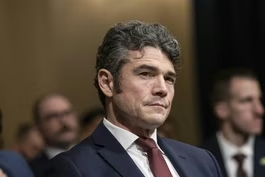
What Kent’s resignation says about U.S. intelligence
Video has Closed Captions
What Joe Kent’s resignation says about U.S. intelligence and counterterrorism efforts (5m 49s)
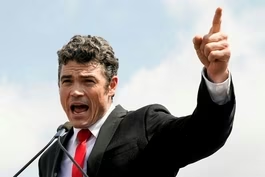
Who is Joe Kent, the U.S. official who quit over Iran war?
Video has Closed Captions
Who is Joe Kent, the counterterrorism official who resigned over the Iran war? (2m 15s)
Providing Support for PBS.org
Learn Moreabout PBS online sponsorship
- News and Public Affairs

FRONTLINE is investigative journalism that questions, explains and changes our world.

- News and Public Affairs

Today's top journalists discuss Washington's current political events and public affairs.












Support for PBS provided by:
Major corporate funding for the PBS News Hour is provided by BDO, BNSF, Consumer Cellular, American Cruise Lines, and Raymond James. Funding for the PBS NewsHour Weekend is provided by...