
December 29, 2025 - PBS News Hour full episode
12/29/2025 | 57m 46sVideo has Closed Captions
December 29, 2025 - PBS News Hour full episode
Monday on the News Hour, President Trump announces a first ground attack on Venezuela and endorses Israel's position in Gaza. How artificial intelligence grew exponentially in 2025, and whether the boom could become a bubble. Plus, arts programs that help give hope to wounded warriors.
Problems playing video? | Closed Captioning Feedback
Problems playing video? | Closed Captioning Feedback
Major corporate funding for the PBS News Hour is provided by BDO, BNSF, Consumer Cellular, American Cruise Lines, and Raymond James. Funding for the PBS NewsHour Weekend is provided by...
December 29, 2025 - PBS News Hour full episode
12/29/2025 | 57m 46sVideo has Closed Captions
Monday on the News Hour, President Trump announces a first ground attack on Venezuela and endorses Israel's position in Gaza. How artificial intelligence grew exponentially in 2025, and whether the boom could become a bubble. Plus, arts programs that help give hope to wounded warriors.
Problems playing video? | Closed Captioning Feedback
How to Watch PBS News Hour
PBS News Hour is available to stream on pbs.org and the free PBS App, available on iPhone, Apple TV, Android TV, Android smartphones, Amazon Fire TV, Amazon Fire Tablet, Roku, Samsung Smart TV, and Vizio.
Providing Support for PBS.org
Learn Moreabout PBS online sponsorshipNICK SCHIFRIN: Good evening.
I'm Nick Schifrin.
Geoff Bennett and Amna Nawaz are away.
On the "News Hour" tonight: President Trump on the world stage, announcing a first ground attack on Venezuela and endorsing Israel's position in Gaza.
The A.I.
explosion.
How artificial intelligence grew exponentially in 2025 and whether the boom could become a bubble.
And artful healing, arts programs that help give hope to wounded warriors.
HOLLY JACOBSON, CEO, Path with Art: We have a mental health crisis.
There's no one magic pill that's going to solve it all.
And so the arts can play a role in helping fill that gap.
(BREAK) NICK SCHIFRIN: Welcome to the "News Hour."
The United States has launched its first ground attack against Venezuela since the administration began its campaign to combat drug trafficking and pressure President Nicolas Maduro.
We don't have many details, but President Trump confirmed the explosion today and said the target was along Venezuela's shore.
DONALD TRUMP, President of the United States: There was a major explosion in the dock area where they load the boats up with drugs.
So we hit all the boats.
And now we hit the area.
It's the implementation area.
That's where they implement.
And that is no longer around.
NICK SCHIFRIN: This week, the U.S.
deployed even more military assets to the Caribbean, adding to what is already the largest deployment of the U.S.
Navy to that region in half-a-century.
It's allowed the U.S.
to strike at least 29 alleged drug boats and seize two sanctioned Venezuelan oil tankers and pursue a third.
But the president wasn't focused only on Venezuela.
Today, Russian President Vladimir Putin told Trump that Ukraine had tried to attack one of his residences.
That's a claim that Trump accepted.
DONALD TRUMP: It's a delicate period of time.
This is not the right time.
It's one thing to be offensive, because they're offensive.
It's another thing to attack his house.
It's not the right time to do any of that, and can't do it.
NICK SCHIFRIN: Ukrainian President Volodymyr Zelenskyy today strongly denied that Ukraine had launched the attack, calling it -- quote -- "an obviously fake story that will only justify Russia's refusal to end the war."
And when it comes to the Middle East, today, President Trump threatened to restart war in Iran, accusing the country of -- quote -- "trying to build up again."
And the president, who has declared himself the president of peace, said Hamas must disarm before any progress can be made at finalizing a peace deal in Gaza.
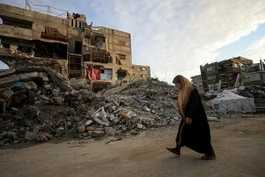
This week, storm clouds loomed over Southern Gaza, its sea of humanity huddled in canvas homes, anxious about tomorrow.
And thunderstorms has flooded makeshift neighborhoods and tents where floors turned to mud and babies were wrapped up to protect from the cold.
The U.N.
says 80 percent of Gaza is in ruins.
There's a U.S.
plan to reconstruct, but President Trump said today the first move was Hamas'.
DONALD TRUMP: If they don't disarm, as they agreed to do, they agreed to it, and then they will be hell to pay for them.
And we don't want that.
I'm not concerned about anything that Israel's doing.
I'm concerned about what other people are doing or maybe aren't doing.
NICK SCHIFRIN: The cease-fire agreement requires Hamas to disarm, but the group maintains it has a right to armed resistance, although it has discussed freezing or storing its arsenal.
The cease-fire also requires all military operations suspended.
The Palestinians accuse Israel of launching hundreds of attacks that since the cease-fire began have killed more than 400.
Israel says they're responding to Hamas' violations, including fighters crossing over from the western side of the yellow line to the Israeli-controlled eastern side.
Senior U.S.
and European officials say the plan for phase two is to rebuild Rafah and Eastern Gaza, not Western Gaza, to persuade Palestinians to leave their destroyed Western Gaza homes and cross the yellow line, while handing over weapons for cash.
The idea, isolate Hamas in Western Gaza, making them an easier target.
At the same time, Israeli forces would withdraw from their bases along the yellow line to be replaced by countries that officials say could include Italy, Azerbaijan and Indonesia.
Today, President Trump suggested Arab countries that supported the cease-fire could themselves disarm Hamas.
DONALD TRUMP: Because they were for the deal based on the fact that Hamas pledged, they swore that they were going to disarm.
Now, if they're not going to disarm, those same countries will wipe out Hamas.
NICK SCHIFRIN: But U.S.
officials say there is no final deal with those or any countries to actually deploy into Gaza.
And there's also no agreement on Gaza's future governance, which, in addition to a Trump-led Board of Peace, requires the naming of an apolitical Palestinian committee.
For more, we turn to two "News Hour" regulars, David Makovsky of the Washington Institute for Near East Policy and Hussein Ibish of the Arab Gulf States Initiative.
Thanks very much.
Welcome back to the "News Hour" to both of you.
(CROSSTALK) NICK SCHIFRIN: Hussein, let me start with you.
HUSSEIN IBISH, Senior Resident Scholar, Arab Gulf States Institute: Sure.
NICK SCHIFRIN: You just heard at the end there President Trump said that Arab countries would go in and disarm Hamas if Hamas did not disarm itself.
Is that possible?
HUSSEIN IBISH: No one is going to do this dirty work.
No one is going to clean up Israel's mess for it or Hamas' mess.
These are the two parties that have created the reality in Gaza.
There is no third party that's going to come in and resolve it to everyone else's satisfaction.
So that's a fantasy.
And it's a fantasy that's existed from day one.
But people should abandon that fantasy because it's not going to happen.
NICK SCHIFRIN: Abandon that fantasy?
DAVID MAKOVSKY, Senior Fellow, Washingto Institute for Near East Policy: Look, I think where Hussein and I agree is, we don't see, A, Hamas voluntarily disarming.
They rule through weapons like AK-47s and the like.
And we also agree that no international stabilization force, peacekeepers, call them whatever you will -- and I talk to Arab officials all the time and say, David, we're not going in there.
It's dangerous.
DAVID MAKOVSKY: So it's basically down to Israel.
Or I was in Ramallah just recently.
I just came back from the West Bank and Israel.
And the Palestinian Authority is willing to go in right now.
This government doesn't want it.
HUSSEIN IBISH: That's the answer, though.
It's other Palestinians can disarm Hamas, but nobody else.
NICK SCHIFRIN: But, of course, Israel rejects the Palestinian Authority going in, right?
HUSSEIN IBISH: Absolutely.
Right.
And, in fact, Israel prefers to deal with Hamas than the P.A., because if you have a deranged enemy with an impossible goal like Hamas, that's kind of good for you.
If you regard all Palestinians as the enemy, much more dangerous is the Palestinian Authority, which wants a small Palestinian state in the West Bank alongside Israel.
That's an achievable goal.
And that's scary for the Israelis.
NICK SCHIFRIN: David Makovsky, let me ask you this.
I mean, you guys have been saying that no one will go in and do this.
Israel and Hamas have to do this themselves.
But does Israel want to go to the phase two?
And, frankly, does Hamas want?
Or are they both satisfied with the status quo?
And are they fearful of taking that next step?
DAVID MAKOVSKY: No, no, look, I think it's a very fair question.
And for our viewers, there's a lot of detail.
So, I mean, I think what we're looking at in here, Hussein and I might disagree, I see two Gazas right now.
I see the yellow line, meaning within the Green Zone, where there's basically no Hamas or -- of substantial numbers.
NICK SCHIFRIN: This is basically east or south of that... DAVID MAKOVSKY: Right, whatever you want to call that.
NICK SCHIFRIN: Israeli-controlled Gaza.
DAVID MAKOVSKY: Right, Israeli-controlled, which is 53 percent.
And, there, you could see some construction in Rafah.
And you can envisage things getting better.
The red zone, though, is where 90 percent of the Gazans actually live and, I should say, where almost all the trucks are going on the humanitarian side, 4,200 a week.
That's 600 a day.
I remember we used to talk about 100 trucks during the war.
Now there's 600 a day.
But Hamas is there.
And I feel the only ones are either Israel or the Palestinian Authority.
HUSSEIN IBISH: That's it.
DAVID MAKOVSKY: Hussein thinks that Israel's fine.
No, that Israel can live with that.
And I am not as certain as... NICK SCHIFRIN: So you think Israel doesn't want the status quo?
DAVID MAKOVSKY: No, I think they give this until March.
They will say we gave this a half-a-year for the second Gaza, the red zone Gaza.
We're fine with the green zone Gaza.
We will do whatever Trump wants.
We will do whatever you want.
But on the Hamas Gaza, if they don't disarm by March, when the weather starts getting better, Israel's going to start going in there in slices militarily.
HUSSEIN IBISH: I actually agree with that.
I think that's right.
But, again, we're going to be back in the same unwinnable war.
Israel's not going to do better in phase five of this war than they did in the first four phases, that I count anyway.
And now they're controlling not 53 percent, 58 percent.
Almost all of the fertile land in Gaza is controlled by Israel.
But almost all the Palestinians are huddled together on these sandy beaches, where there's nothing.
And it's not a sustainable reality for any of the three parties, for the Palestinian people, not at all.
For Israel, as David said, they're not going to be satisfied.
And in the end, Hamas is not going to be happy either.
So this war is likely to start again, especially if the Israeli election is already over.
I'm not sure Netanyahu wants... NICK SCHIFRIN: ... has to be by the fall of 2026, right.
HUSSEIN IBISH: By October, but more likely by May or something, June.
HUSSEIN IBISH: I'm not sure Netanyahu wants to go into the election pursuing an unpopular war.
DAVID MAKOVSKY: Well, the... NICK SCHIFRIN: No, no, has Israel and Hamas - - and let me ask you first, David Makovsky.
Have Israel and Hamas lived up to the cease-fire so far?
DAVID MAKOVSKY: OK, I think, in the big picture, and we may have some disagreements, Israel released 250 people convicted in courts for killing Israelis.
That was a big deal -- of life sentences -- 1,700 detainees, 4,200 trucks a week, which was critical so people could have food at least, even though it's inadequate, as your setup piece says, because it's winter there.
So, I mean, I don't -- but I think that those to me were some of the big ticket issues.
Are there things like the Rafah Crossing?
It's a very fragile cease-fire.
There are there all sorts of complaints about violations on all sides.
But I think, in the big picture, yes.
I just think the disarmament issue is not a footnote.
It's central.
If there's going to be a hope for the Gaza people, Hamas has got to get out of the way.
And I don't see who's getting them out of the way.
I disagree respectfully with the president that 59 countries are going to wipe them out.
And I just don't think that happens.
And you want to solve these things peacefully if you can.
But I think Hamas' view is, in the Middle East, the people who fire the shots call the shots, and they fire the shots.
So, no one is going to displace them.
NICK SCHIFRIN: Hussein Ibish, sorry.
Have Israel, have Hamas lived up to the cease-fire?
HUSSEIN IBISH: Well, I was about to address that.
No, not really, because the key part of the cease-fire is stopping firing, ceasing firing.
And that hasn't happened.
Hamas has been doing incursions, but Israel has been keeping up a barrage of seven to nine people a day killed.
And it's over 400.
At least 80 of them are children.
That's not a cease-fire.
In any other situation, you would say the war continues to bleed these people.
It's only in comparison to the 90 a day or so that we had before.
So I would say the answer is no.
And the only alternative to Hamas is a Palestinian one.
And it's the one thing I know Netanyahu is never going to agree to.
NICK SCHIFRIN: David Makovsky, just very quickly, I want to bring up what I brought up at the end of the piece.
That is this plan to rebuild Rafah, which you mentioned, Eastern Gaza, as a way to incentivize Palestinians, not only to move, to leave their land right now, which will remain unconstructed, and move across the yellow line and disarm for money.
We only have about 40 seconds left.
Is that a realm of possibility that that could actually work?
DAVID MAKOVSKY: I don't think it will in significant terms.
Like, 90 percent of the Gazans right now are on the Hamas side of the yellow line.
What did we say, whatever, 43 percent of the West Bank -- 50 -- 47 percent of the West Bank -- of Gaza.
Excuse me.
I don't see the Gazans leaving their land for a promise on the other side, when all the main cities are on the Hamas side.
So that's why, to me, this was such a critical meeting in Mar-a-Lago.
Is there a meeting of the minds about the red zone, about the Hamas side?
Everything else, you could work around.
HUSSEIN IBISH: This solution is not nonstarter.
It's not going to happen.
The answer is no to your question.
The answer is, no, that's not going to work.
And neither is the status quo.
So I'm afraid a return to war is very likely.
NICK SCHIFRIN: We will have to leave it there.
Hussein Ibish, David Makovsky, thanks to all -- to both of you.
HUSSEIN IBISH: Thank you so much.
DAVID MAKOVSKY: Thank you.
NICK SCHIFRIN: Thank you.
HUSSEIN IBISH: Great to be with you.
NICK SCHIFRIN: The day's other headlines begin with a massive storm spinning east with a dangerous mix of winter weather that snarled post-holiday travel for millions of Americans.
Heavy snow and driving winds created whiteout conditions for drivers across much of the Midwest, causing accidents and one death in Iowa.
More than 300,000 customers remain without power this evening, nearly a third of them in Michigan.
Meantime, airlines are scrambling to get back on schedule after the storm canceled or delayed tens of thousands of flights in the last three days.
Snow will continue around several of the Great Lakes through much of the week.
The man charged with placing two pipe bombs in Washington, D.C., on the eve of the January 6 Capitol attack says he did so because he believed someone needed to -- quote -- "speak up."
In a new court filing, prosecutors said Brian Cole Jr.
told investigators he believed the 2020 election was stolen and he placed bombs at the Republican and Democratic National Committee headquarters to target both political parties since they were -- quote -- "in charge."
The explosives did not go off.
Cole was arrested earlier this month after a nearly five-year investigation.
He has a detention hearing set for tomorrow.
Returning to the war in Ukraine, President Volodymyr Zelenskyy says the U.S.
offered Kyiv security guarantees for 15 years to deter Russia from returning to war after a cease-fire.
But that's far less than what Zelenskyy wanted, up to 50 years of guarantees.
In a briefing with reporters conducted via WhatsApp, Zelenskyy said President Trump would think about extending the time frame.
Zelenskyy added -- quote -- "Without security guarantees, realistically, this war will not end."
Meanwhile, in the Ukrainian capital, Kyiv, at a permanent memorial, residents shared Zelenskyy's concern that Russian President Vladimir Putin could resume the war even if peace were reached.
NATALIA FOMINA, Kyiv Resident (through translator): We see our enemy.
We know that talks don't stop him.
Only real strength can stop him.
So it's unlikely that these talks will stop the war.
NICK SCHIFRIN: On the cease-fire talks, the fate of Ukraine's Eastern Donbass region and the Russian-held Zaporizhzhia nuclear power plant remain unresolved after weekend talks between President Zelenskyy and Trump.
Meanwhile, in Taiwan, China staged a massive military exercise around the island today, possibly its largest live-fire drills ever.
Beijing called them -- quote -- "a stern warning" against outside interference.
The drills come as Beijing promised to -- quote -- "take forceful measures" after the Trump administration approved the largest single weapons package to Taiwan in U.S.
history.
Taiwan has placed its forces on high alert.
But President Trump tonight dismissed Taiwanese concerns, saying -- quote -- "Nothing worries me.
They have been doing naval exercises," meaning Beijing, "in the area for 20 years."
Today, the U.S.
announced its first major humanitarian agreement of the second Trump administration in the U.S.
to distribute humanitarian aid with the United Nations.
The U.S.
pledged $2 billion, which the U.N.
's emergency chief called landmark, but it's a fraction of the money the U.S.
has historically contributed to U.N.
agencies every year.
The U.S.
says the new funding mechanism is an attempt to reduce bloat by funneling money to a coordinating U.N.
agency, rather than individual agencies like UNICEF.
Today's U.S.
pledge also came with a threat.
Those U.N.
agencies, the State Department said, must -- quote -- "adapt, shrink, or die."
President Trump today repeated a threat that he may sue Federal Reserve Chair Jerome Powell for - - quote -- "gross incompetence."
He also said he would announce the next Fed chair sometime in January.
Meantime, on Wall Street stocks slipped from their recent record highs.
The Dow Jones industrial average lost more than half-a-percent.
So too did the Nasdaq.
And the S&P 500 also closed slightly lower.
Still to come on the "News Hour": the president pushes for the release of a former Colorado election official who tried to subvert the will of the voters in 2020; Tamara Keith and Amy Walter break down the latest political headlines; and from our video podcast "Settle In," author Malcolm Gladwell on the virtue of changing your mind.
This year, perhaps the most significant business and economic story has been the development and spending around artificial intelligence.
A.I.
spending is driving one of the tech industry's most explosive periods and playing a big role in overall U.S.
economic growth.
A few companies are churning immense profits, most of all Nvidia, which posted record gains of $32 billion, a 65 increase in one year.
But there are very real questions about whether this is a bubble.
Geoff Bennett dived into that in a conversation he recorded recently.
GEOFF BENNETT: Experts say this boom exceeds almost anything else you can imagine, spending that goes beyond what was spent on the Manhattan Project and the Apollo missions to space.
But a number of experts are concerned that the trillions of dollars spent and intense competition is creating an A.I.
bubble that won't sustain the kind of earnings growth to match all of that investment.
And if the bubble bursts, it could affect more than just Silicon Valley.
For more, we're joined now by Cade Metz, technology reporter for The New York Times who covers the world of A.I.
Thanks for being with us.
CADE METZ, Technology Reporter, The New York Times: Glad to be here.
GEOFF BENNETT: So let's start with the basics.
What is driving this explosion of A.I.
investment?
Why does it seem like all these companies are piling in at once?
CADE METZ: Well since the arrival of the chatbot ChatGPT about three years ago, we have seen this technology steadily progress and slowly work its way into people's lives, into the lives of office workers.
In many ways, it's a transformative technology.
It's helping people search the Internet in new ways.
And, inside offices, it's helping to transcribe meetings, helping doctors and other professionals do their jobs maybe a little bit faster.
But Silicon Valley sees much bigger things ahead.
They see this technology continuing to improve, becoming more and more powerful over the next few years.
So they're investing those hundreds of billions of dollars into the data centers that not only allow them to improve this technology, but serve it up to a much larger portion of the population.
GEOFF BENNETT: And, overall, you have got trillions of dollars flowing into A.I.
Is this growth sustainable or are we in a bubble territory here?
CADE METZ: That's the question that everybody's trying to answer and no one can quite answer.
This is enormous spending, to say the least.
And it's a bet on the future.
These data centers are not only expensive.
They take years to build.
So all these companies not wanting to miss out on this big boom are having to make a bet two, three, four years into the future that they will be able to pull in the revenues to pay for this.
Maybe they can.
Maybe they can't.
No one can quite agree.
It's really a timing issue.
The revenues are already coming in for a lot of these companies.
It's a question of how quickly it will come in and how many companies can pull in those revenues.
There are so many companies in this race.
A lot of people believe not all of them can win out.
GEOFF BENNETT: Is that why it's so hard for these companies to establish A.I.
dominance?
CADE METZ: In part.
You have got many big players.
The Googles and the Microsofts and the Amazons of the world are doing this.
And then you have got more nimble start-ups like OpenAI and Anthropic.
Meta recently doubled down on this, the company that owns Facebook and Instagram.
They have built a new A.I.
lab.
Elon Musk is in the mix.
People in the Valley talk about FOMO here, the fear of missing out.
No one wants to miss out on this technology.
So the race has expanded even over the past year.
GEOFF BENNETT: Let's return to the data centers, which you mentioned, because the spending there has just been enormous.
What risks does that pose to the markets, to energy systems, and to the broader economy?
CADE METZ: To the broader economy, the concern here is that so much debt is being taken on to build these data centers.
For years, the big players I mentioned, the Googles and the Amazons and the Microsofts, built these giant data centers largely with cash on hand or essentially with cash on hand.
Those are companies that pull in billions of dollars in revenues a year.
They can afford to build these facilities.
But you have got so much demand for this extra computing power that so many other companies are now in the mix and building these data centers for various reasons, either for themselves or for their partners.
And those companies are taking on far more debt than we have seen in the past.
And that's where the risk comes in.
Eventually, that debt has to be repaid.
And if the revenues aren't coming in from these companies by that time, you have a problem.
GEOFF BENNETT: So it's this idea of a circular loop.
You have the tech giants investing in the A.I.
firms, which then use that money to invest in those same tech companies' infrastructure.
Is that why folks are raising a red flag?
CADE METZ: Well, that's part of what's going on.
All these companies are partnering up, hoping to kind of bootstrap the whole industry and move it forward.
And so you do have deals like that, where, for instance, one company will take investment from one of the big giants and then immediately spend that money with the same company.
They see that as partnership.
Others see that as a sign that the market may not be as healthy as it seems.
GEOFF BENNETT: What about on the substance, the concerns about how A.I.
is being deployed, often poorly with little regulation, a flood of low-quality, misleading content on the Internet?
How are the companies responding to those concerns and worries?
CADE METZ: Well, in some cases, they're working to address that disinformation issue you talk about.
These systems do make mistakes.
They do cause problems.
We have got three years documenting all that.
And there are constantly efforts to improve that problem.
But you have to realize this technology fundamentally makes mistakes.
This is a technology that is built by analyzing vast amounts of data culled from across the Internet.
It looks for patterns in that data.
And that's how it learns its skills.
But that also means that, as it learns, it's going to make mistakes.
It's going to learn from bad data, but it's also going to make mistakes just because these are probability engines, right?
They're doing something based on what they have seen in the data.
And that means, fundamentally, a percentage of the time they're going to make mistakes.
People have to realize that that's always in the mix.
And that can also -- in addition to causing all sorts of problems in -- just in the information as it's distributed across the Internet, it can cause problems in other ways these systems behave.
The hope is that these systems will do more and more important tasks as the years come.
But if those mistakes are in the loop, it becomes harder to complete those tasks.
GEOFF BENNETT: Problems, to be sure.
What about the promise, the promise of A.I.?
What have you encountered in your reporting that you find most exciting?
CADE METZ: The most exciting part of this, I think, is in health care.
What we have seen is, the technology that drives something like the chatbot ChatGPT, which many people are now familiar with, that same technology can be used to aid drug discovery.
Essentially, it can help design medicines and vaccines that can help deal with illness and disease.
That's the most powerful aspect of the technology, in some ways the most promising, and in other ways the most important.
GEOFF BENNETT: Cade Metz of The New York Times, thanks again for your time.
We appreciate it.
CADE METZ: Thank you.
NICK SCHIFRIN: President Trump's use of pardons is a Rorschach test of sorts on how people view his second term.
For some, he's undoing Justice Department - - quote -- "weaponization."
For others, he's letting loyal followers get away with crimes.
Earlier this year, President Trump pardoned around 1,500 people for their involvement in efforts to overturn the 2020 presidential election.
As we near the fifth anniversary of the January 6 Capitol attack, one high-profile election denier remains behind bars.
And, as White House correspondent Liz Landers reports, there's little Trump can do to get former Colorado county clerk Tina Peters out of prison.
LIZ LANDERS: President Donald Trump has been on a pardoning spree of late, using his executive power to bestow clemency on convicted businessmen and the former president of Honduras.
DONALD TRUMP, President of the United States: No autopen necessary.
TINA PETERS, Former Colorado County Clerk: Well, they didn't make a mistake.
They erased it.
LIZ LANDERS: He recently announced on social media that he was pardoning Tina Peters, a former Colorado County clerk, though his pardon power only covers federal crimes, not her state convictions.
He wrote online that Democrats had -- quote -- "been relentless in their targeting of her."
DONALD TRUMP: She caught people cheating on an election and they said she was cheating.
She wasn't cheating.
LIZ LANDERS: She may not be a household name, but Peters' case has become a rallying cry for MAGA and the president since her conviction last year.
Tina Peters served as the Mesa County clerk administering elections in the Colorado community after being first elected in 2018.
A Republican, Peters became a vocal election denier, questioning the 2020 results and the voting machines used to conduct them.
TINA PETERS: No one has addressed looking into the machines to see what has been happening by these vendors, by this vendor that manufactures the machines and what goes on.
It's been a mystery box, a mystery black box.
LIZ LANDERS: In 2021, Peters allowed someone associated with MyPillow CEO Mike Lindell to misuse a security card to gain access to the county election system and lied about his identity.
PETER TICKTIN, Attorney For Tina Peters: And she knows what she did.
And she knows what she did was brave, but it wasn't wrong.
LIZ LANDERS: Her attorney, Peter Ticktin, says Peters doesn't regret her actions.
PETER TICKTIN: Her to admit to wrongdoing would have to be because she's either brainwashed herself or others brainwashed her or, I mean, she'd be living a falsity.
LIZ LANDERS: Peters was charged in 2023 with 10 counts related to the scheme.
A Republican district attorney prosecuted the case.
She was convicted in summer of 2024 of seven of those charges, three counts of attempting to influence a public servant, one count of conspiracy to commit criminal impersonation, first degree official misconduct, violation of duty and failing to comply with the secretary of state.
The district judge sentenced her to nine years in prison, not mincing words at her sentencing.
JUDGE MATTHEW BARRETT, Mesa County District Court: Your lies are well documented and these convictions are serious.
I'm convinced you would do it all over again if you could.
You're as defiant as a defendant as this court has ever seen.
You are no hero.
You abused your position.
And you're a charlatan.
LIZ LANDERS: During his second term, President Trump has repeatedly pressured the Justice Department and Colorado officials to pardon or release Peters, writing in August -- quote -- "If she is not released, I'm going to take harsh measures."
Democratic Colorado Secretary of State Jena Griswold spoke to "PBS News Hour" about that pressure campaign.
JENA GRISWOLD (D), Colorado Secretary of State: What happens with Trump is, he tries to push the line, tries to push, people pretending he has authority that he does not.
And if they refuse an unlawful order or an unlawful executive order or request, then the retaliation starts from him, but also the far right.
LIZ LANDERS: This is just the latest in a series of moves to rewrite the 2020 election.
The president recently pardoned prominent members of his 2020 campaign legal team who had not been charged with federal crimes, including Rudy Giuliani and attorney Sidney Powell.
And on his first day in office, he pardoned more than 1,500 January 6 defendants.
Griswold says that Trump's pardon for Peters has clear limits.
JENA GRISWOLD: She was convicted under our state laws in a state court, and the president does not have authority to issue pardons for state convictions.
That's very clear in the Constitution.
DANIEL DAY-LEWIS, Actor: I need this!
LIZ LANDERS: But Peters attorney believes the Constitution is being misinterpreted, a revelation that struck him as he watched the 2012 film "Lincoln."
DANIEL DAY-LEWIS: I am the president of the United States of America, clothed in immense power!
PETER TICKTIN: We're looking at it now post the Civil War, when the central government, the federal government, became the strong central government that it is, that really made the United States into one cohesive government, one cohesive country, instead of a conglomeration of countries, which it originally was.
So when the framers wrote, for offenses against the United States, they weren't talking about it.
They were talking about them.
LIZ LANDERS: Are there any examples that you can think of a president pardoning a state crime or state conviction?
PETER TICKTIN: So there are, but I really need to delve into it a little bit deeper.
LIZ LANDERS: Colorado's Democratic Governor Jared Polis said after the president's announcement that the courts will decide the matter.
Ticktin hopes it reaches the highest court in the land.
PETER TICKTIN: The Supreme Court of the United States has -- a good number of the justices are fundamentalists.
They are smart enough to understand that, to understand what the Constitution really means, you have got to look at the minds of the founders.
What did they mean?
LIZ LANDERS: Griswold, though, argues the repercussions would be felt far and wide if Peters walks free.
JENA GRISWOLD: It would set the precedent that people can attack our elections and potentially disenfranchise Americans without any type of consequences.
It would also set the precedent that, if people break the law and our friends with Donald Trump, they won't face consequences.
That's a direct assault to the rule of law in this country.
And it just cannot stand.
LIZ LANDERS: For the "PBS News Hour," I'm Liz Landers.
NICK SCHIFRIN: What a political year it has been.
President Trump returned to the White House and used the office to expand presidential power in unprecedented ways.
And members of both parties in Congress have scrambled to adjust.
Our Lisa Desjardins is here with more.
LISA DESJARDINS: 2025 certainly brought Trump back into our daily political lives, but what did it reveal about him and what did he reveal about the country?
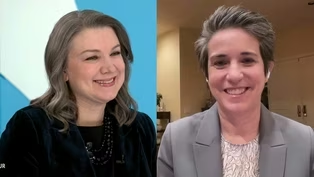
Perfect questions and timing for Politics Monday, our duo of Amy Walter of The Cook Political Report With Amy Walter and Tamara Keith of NPR.
Tamara, let me start with you.
You're right there at the White House.
What did this year reveal about Trump and our balance of power?
TAMARA KEITH, National Public Radio: Well, the balance of power isn't what it used to be.
And President Trump was revealed to have -- we knew this, but now we really know it.
He has a very expansive view of his executive authority.
And there are fewer people around him who see themselves as guardrails.
So he has done -- he's signed more than 200 executive actions.
He has sort of barreled into Washington, done what he wanted to do and waited for people to stop him.
And then there haven't been that many things to stop him.
The White House and the president have claimed expansive Article 2 powers.
And Congress has sort of shrugged and has done very little to push back.
And I think the jury is still out on the courts.
LISA DESJARDINS: Amy?
AMY WALTER, The Cook Political Report: I agree with those.
And the courts are going to be very important.
Some of the issues in which he has really expanded authority beyond the norms of anything that we have seen sort of in this modern era include tariffs and trade.
And the court is going to weigh in on that.
And it may be the one place, at least in 2026, where the court does deliver a loss to the president.
That is the assumption from many who watched that case being debated.
But it's also remarkable the degree to which the president has been able not just to reassess the relationship between the executive and the legislative branch, but also the role that the executive branch is playing in pretty much every aspect of American life, the pressure campaign that the Trump administration has put onto, and in many cases successfully done, with academic institutions, law firms, cultural institutions.
Obviously, we know the Kennedy institution and the Kennedy Center being a prime example of that, but being able to really push many of these institutions to, for example, cancel or curtail their DEI programs.
This is not something that we normally think of as executive authority, but I think it speaks to the point Tam brought up earlier, that this is a president who believes that the executive has power that goes beyond just what sorts of laws are being determined out of Washington.
LISA DESJARDINS: Amy, his supporters, of course, like a lot of the things that Trump has been doing, as you're saying here.
But, to Democrats, they see a barrage of a president who has shut down agencies that they thought were independent, sent in a billionaire and his proteges to literally traumatize federal workers, a very aggressive, the most aggressive tactics I think we have seen in generations by ICE.
Amy, what have Democrats done in reacting and what have they not done and why?
AMY WALTER: So I think what's really interesting about all of this, Lisa, you have a president who came into office with pretty decent approval ratings, not great, but pretty decent approval ratings.
And for the first time, Democrats really had to reassess the way in which they looked at and the way that -- the sorts of tactics they were taking in opposition to Donald Trump.
In his first term, they sort of consoled themselves with this idea that he was deeply unpopular, he didn't win the popular vote, and that he was something of an anomaly.
By the end of 2024 and into the beginning of 2025, those assumptions were no longer true.
This is a president who won the popular vote and came into office with the public being somewhat optimistic about what he would be able to do, especially on the economy.
Well, now here we are a year later.
His approval rating, even as he's accomplished so many of the things he set out to accomplish, his approval rating very deeply underwater, specifically on the economy.
And I think what Democrats are recognizing right now, which is very different from where they were, say, at this point in 2017, is that a campaign going into the midterms about, like they did in 2017, that focuses on all the norms that Trump is breaking, is not going to have the salience that it did back then.
Instead, they're focusing on this issue of affordability.
Really, the broken promise they argue that Trump made in his campaign to lower prices, that's where they're going to be spending most of their time.
So it took them much of the year to get to this point, but I think that's what we're going to see the 2026 campaign center on.
LISA DESJARDINS: In this conversation about Democrats, former Labor Secretary Robert Reich today had an op-ed in The Guardian, where -- the headline there is: "Americans Are Waking Up."
He says a reckoning is coming.
That's from the Democratic side.
We have been talking about President Trump, but yesterday in The Wall Street Journal, we saw an op-ed from Speaker Mike Johnson, who claims there that Republicans had a great year.
And, certainly, he has, I think, exceeded expectations.
But, Tam, I want to ask you.
The speaker wants to talk about Republican tax cuts, but what's at risk for him politically from this past year?
TAMARA KEITH: Yes, so the speaker absolutely wants to talk about that One Big Beautiful Bill that is the one thing that they really were able to get done.
And it was a Christmas tree, to borrow from the season.
It had a lot of things piled onto it that were part of the Republican wish list, part of President Trump's campaign promises.
So that includes a lot of funding for ICE and also these tax cuts.
I think the real risk for Speaker Johnson is just that his own members are not happy with him.
They are vocally not happy with the way he's managed the House of Representatives, from taking the House out of session for the entirety of the government shutdown, when they could have been doing other things, to not letting members who are at risk of losing in the midterms push forward legislation that they believe their constituents need.
And the evidence of this are these discharge petitions, which, when I was first covering Congress back in 2010... LISA DESJARDINS: When we first met, yes.
TAMARA KEITH: When we first met all those years ago, those discharge petitions were a joke.
It was a thing the minority did because they couldn't do anything else.
So, they'd say, oh, I have got a discharge petition.
Well, now members of the majority are using a discharge petition to express their displeasure with the speaker.
However, he's pretty safe because President Trump likes him and there's almost no one else who could do that job.
LISA DESJARDINS: So much to talk about in the last year.
On Tuesdays, I put out a political newsletter called Here's the Deal.
And at the end of the year, we have a tradition where we kind of come with the political word of the year.
Our readers vote on it.
They had to choose from four, dismantle, affordability, shutdown, and immigrant.
We will announce the winner in the newsletter tomorrow.
But I want to ask you what you think the political word of this year might be in our last minute or so, Amy.
No pressure.
AMY WALTER: Well, affordability clearly -- yes, exactly.
(LAUGHTER) AMY WALTER: Affordability is up there, but I would put another one in there, which is re-redistricting.
This was a year in which we saw more districts be redrawn mid-decade than in any time in political history.
And what we're -- what's not clear, Lisa, is whether this was a one-time thing or whether this is now going to be something of a norm, and, as such, it will be in your dictionary for years to come.
LISA DESJARDINS: Tam, you get the last political word of the year.
TAMARA KEITH: I was going to say gerrymander, but that's basically the same word as Amy.
So let's go with affordability, because I think that is the word that, at the beginning of the year, people weren't using that word.
President Trump likes to say this, and then this new word affordability came around.
Well, in fact, it is a word that has sort of shot up in the lexicon in terms of the amount that people are discussing it.
And it really speaks to the points of pain for voters and what they're expressing in the polls.
The reason the president's underwater on the economy... why people are pessimistic, it's affordability.
LISA DESJARDINS: Tamara Keith, Amy Walter, thank you both so much.
TAMARA KEITH: You're welcome.
AMY WALTER: You're welcome.
NICK SCHIFRIN: Post-traumatic stress is far too common among veterans.
Ten percent of men, nearly 20 percent of female veterans report symptoms at some point in their lives.
But could the arts provide a needed prescription?
Stephanie Sy reports from Seattle for our ongoing coverage of the intersection of arts and health, part of our Canvas series.
(SINGING) STEPHANIE SY: On a recent afternoon at the Seattle Opera, a group of military veterans prepares for an upcoming performance.
WOMAN: OK.
Not a bad review.
Thank you.
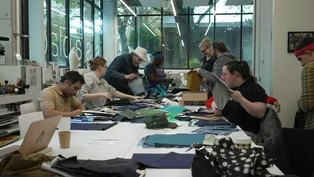
STEPHANIE SY: This veterans choir is part of Path with Art, a Seattle nonprofit that offers a range of programming designed to promote public health.
WOMAN: Let's go again.
STEPHANIE SY: For Shanda De Anda, who served 24 years in the United States Air Force, the once a week ritual of singing with fellow service members has been healing.
MASTER SGT.
SHANDA L. DE ANDA (RET.
), U.S.
Air Force: Trauma changes who you are as a person.
STEPHANIE SY: De Anda served in combat roles in Iraq, Afghanistan, and Bosnia.
But it wasn't until she retired from the Air Force in 2019 that she began to process all that she'd seen on the battlefield.
She was diagnosed with PTSD.
MASTER SGT.
SHANDA L. DE ANDA (RET.
): But I was like, I'm sure I don't have that.
I'm sure that's not a problem for me.
And then COVID hit, and I lost the ability of being really active and in the community.
And so being alone with my thoughts became more a part of my life.
STEPHANIE SY: She says, when even leaving her house made her terrified, her therapist referred her to Path with Art.
MASTER SGT.
SHANDA L. DE ANDA (RET.
): Joining the veterans choir, where I'd be surrounded by other veterans, is a way of kind of finding my voice again.
STEPHANIE SY: Randy Schoesler has also found a new voice in the veterans choir.
He served in the Air Force for seven years until he says he was kicked out of the military in the early '80s for being gay.
2ND LT.
RANDY SCHOESLER (RET.
), U.S.
Air Force: Randy Schoesler, I was very much in the closet, because, at the time, this was before don't ask, don't tell even.
There was no defense.
If you were found to be gay, it was instant discharge.
STEPHANIE SY: What did you go through?
2ND LT.
RANDY SCHOESLER (RET.
): Well, first, it was the shock.
Then I lost my job because my clearance was immediately ripped.
STEPHANIE SY: Schoesler struggles with depression.
He's been coming to Path with Art for six years.
2ND LT.
RANDY SCHOESLER (RET.
): I need community.
I need camaraderie.
I need to be able to express myself.
STEPHANIE SY: Path with Art has offered classes on everything from learning the basics of podcasting... MAN: You both have nice big voices.
MAN: Really?
STEPHANIE SY: ... to pottery, acting and fashion design.
The classes are available to low-income adults and all veterans for free.
HOLLY JACOBSON, CEO, Path with Art: We have a mental health crisis.
There's no one magic pill that's going to solve it all.
And so the arts can play a role in helping fill that gap.
STEPHANIE SY: Holly Jacobson, the CEO of Path with Art, says since launching the veterans program in 2019, participation has skyrocketed.
HOLLY JACOBSON: It really did show that there was a need.
So it's now a quarter of our program, over 500 individuals last year.
SPC.
DONNA BAKER (RET.
), U.S.
Army: This is supposed to be a wolf.
STEPHANIE SY: Here veterans are also employed as teachers.
Artist Donna Baker teaches art classes using mixed media, including yarn.
SPC.
DONNA BAKER (RET.
): When I get to the point where I can't handle things, I go to art and it just kind of -- it calms me down.
It relaxes my mind.
I feel at ease.
I don't feel anxious.
I don't feel like I have to battle the world.
STEPHANIE SY: Baker was stationed in Germany during the late '80s and early '90s.
A survivor of sexual assault, she says she still struggles with PTSD from her time in the Army.
SPC.
DONNA BAKER (RET.
): In a lot of ways, I can totally connect.
I can totally connect with maybe what they're feeling, their angst, their pain, their suffering.
STEPHANIE SY: Feelings that other military sexual assault survivors like Chris Wisdom share.
She joined the Army in the late '90s.
PRIVATE 1ST CLASS CHRIS WISDOM (RET.
), U.S.
Army: They were telling the females not to go out at night alone because there were a lot of attacks, that there were a lot of rapes.
And it wasn't by civilians coming on post.
It was by your fellow soldiers.
And so the fire represents the anger and then the tears, the sorrow and sadness.
STEPHANIE SY: More than two decades later, her artwork, including this mask, expressed what she went through.
So that mask, I named Explosive Emotions.
I made that to represent when you try to suppress who you are and your feelings for so long with all that you have been through that eventually it's just going to explode.
SUSAN MAGSAMEN, Author, "Your Brain on Art": The folks that have served our country so beautifully have come home and have experienced trauma in a way that many of us can't understand.
STEPHANIE SY: Susan Magsamen is the co-author of "Your Brain on Art" and an assistant professor of neurology at Johns Hopkins University.
Her extensive research has included looking at Path with Arts programs and has found they are effective at improving mental health outcomes.
SUSAN MAGSAMEN: And a lot of times, people talk about well why can't you just get over something?
And trauma is not like that.
And so the way to get out, it turns out that these arts and aesthetic experiences can be incredibly valuable.
Something as simple as singing, which activates your parasympathetic nervous system, activates the vagus nerve, again connects you to each other, calms your physiology and makes you just feel better.
STEPHANIE SY: For Shanda De Anda, it's working.
MASTER SGT.
SHANDA L. DE ANDA (RET.
): For a long time, I was trying to get back to who that version of Shanda was.
But she isn't here anymore.
And mourning that loss and then celebrating the opportunity of developing a new Shanda is something I think Path with Art was extremely instrumental in making that happen.
STEPHANIE SY: For so many here, it's a step away from a painful past toward a more hopeful future.
For the "PBS News Hour" I'm Stephanie Sy in Seattle.
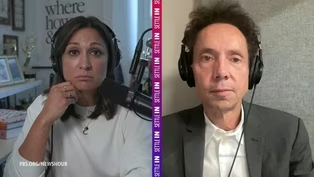
NICK SCHIFRIN: Finally from us, "Settle In" with author Malcolm Gladwell, who says he doesn't trust people who don't change their minds.
He recently sat down with Amna Nawaz for our new video podcast to discuss that and revisit his first book, "The Tipping Point," 25 years later.
AMNA NAWAZ: I wanted to ask you about this, because this has really stood out to me about you and the way you talk about your work and the way you are willing to revisit your own work and to say, I got something wrong.
And the crime example, as you have mentioned, I know you wrote about in "The Tipping Point" that the broken windows policing policies in New York, where the idea that little crimes could be tipping point for big crimes.
And we know over time now years later how that led to very harmful policing policies, like stop and frisk and disproportionately targeting Black and brown people.
And you have come out since then and said, we were wrong.
And I was part of that, and I'm sorry.
And it was so striking to me to have someone with your kind of platform and voice say something like that so definitively.
So I wondered if you would tell me a little bit about what Fed that decision and how hard that was to come out and say, I was wrong.
MALCOLM GLADWELL, Author, "Revenge of the Tipping Point": Well, it wasn't hard at all?
AMNA NAWAZ: No?
MALCOLM GLADWELL: Because I do it all the time.
If you knew me, you would know that my wife is always like, she's -- I so consistently change my mind on things, that she's sometimes looks at me and she's like -- because I will express an opinion.
And she will be like, well, you could change your mind tomorrow.
And I will go, yes, actually... AMNA NAWAZ: I might?
MALCOLM GLADWELL: I might.
AMNA NAWAZ: I probably will.
MALCOLM GLADWELL: Or I will go to a restaurant, and she will be like, I thought you hated that restaurant?
I'm like, yes, I did.
But I changed my mind.
(LAUGHTER) MALCOLM GLADWELL: Or I remember once I was -- I worked with this guy named Martin.
And I was -- I had a -- I had a laptop made by Hewlett Packard.
And he was like, why do you have a Hewlett Packard laptop?
And I went on and on and on and on and on and on and on and on and on and on and on about how, I will not join the Apple universe.
That is -- and I gave all these 17 reasons why it was a bad thing.
And then, like a week later, he comes by and I'm working on an Apple laptop.
And he's like, what -- I said, I changed my mind.
I always change my mind.
I think it's fine.
I don't trust people who don't.
AMNA NAWAZ: Yes, but to be fair, changing your mind on like what restaurant you like or what laptop you use, that's different than something you researched and reported and put into a book and then said, you know what, actually, years later... MALCOLM GLADWELL: Something I researched and reported 25 years ago.
How many things do you believe from -- how many things did you believe 25 years ago that you still believe today?
Like... AMNA NAWAZ: Oh, yes, I'm not saying things don't change.
I'm saying for someone who published a book around one of these ideas to then have the courage and honesty to come out and say that, it feels like we live in a time where people aren't willing to do that.
People will defend, defend, defend, deny, deny, deny.
Like tell you you're not seeing something you're actually seeing.
And you said, you know what?
I actually got it wrong.
That's not the norm.
MALCOLM GLADWELL: Is it?
I mean, maybe it's not the norm in public life, but I feel like ordinary people change their mind all the time.
AMNA NAWAZ: Yes.
MALCOLM GLADWELL: And I feel like -- it's funny.
I put everything through the prism of being a parent now.
Parents, you always -- the whole lesson of being a parent is that you are required to constantly change your mind.
Your kids force you to change your mind nonstop.
It's all they do, right?
You say it's time to go to bed.
And they say, no, it's not.
And you know what happens?
You're wrong.
They're fine.
MALCOLM GLADWELL: They don't go to bed.
So then you learn, oh, maybe my idea that they have to be in bed by 6:45 is a mistake.
And then you change your mind.
And then you -- it's all this kind of like -- you're constantly gathering -- you have a view about - - I have two children.
You have a view about one of them based on your experience with the other.
Then you discover, oh, you're wrong.
They're totally different.
I can't do that with this -- with the second one.
They won't say it.
And so you -- like, it's just -- it's just one -- so I feel like, for ordinary people, I guess there's no ego involved in that as a parent.
AMNA NAWAZ: Yes.
MALCOLM GLADWELL: So you -- it's commonplace.
But there has -- I think you are right in the sense there has been this very weird thing that's been -- maybe it's true that this is recent in public life, where people are scared about changing their mind.
And I don't really understand it, because I don't trust people who don't change their mind.
If you don't -- the only way I would ever give any expert the benefit of my trust is if I observe them gather new evidence and alter their preconceived notion.
AMNA NAWAZ: Why do you think people are scared?
Do you think they're scared of the reaction or scared it makes them look weak?
MALCOLM GLADWELL: Well, I'm the wrong guy to ask because I don't -- I have no understanding.
I don't get it at all.
With crime, I mean, the broader thing with crime, the reason I feel so free to change my mind is that we have been living in the last 25 years in the golden age of criminology, where we have discovered things about crime and we have revised our understanding in incredibly fascinating ways.
The whole field -- like, I talked about -- in one of my other books, I talked about a guy named David Weisburd, who was part of a movement, what's called hot spot policing.
And it's this observation that the crime in any given city, there's a handful of city blocks that year after year are responsible for an overwhelming majority of crime.
Crime is not dispersed throughout an area.
It's concentrated.
And you can identify those concentrated places and you can crack down on those places and you can drive an enormous crime -- this is something we did not know 25 years ago.
I mean, it's -- that and a number of -- a whole series of other things are things that we have discovered by very careful, brilliant work by really, really, really smart people.
So, to be interested in crime is of necessity to have to change your mind.
NICK SCHIFRIN: For the full conversation and more episodes, check out our video podcast "Settle In" on YouTube or wherever you get your podcasts.
And that is the "News Hour" for tonight.
I'm Nick Schifrin.
On behalf of the entire "News Hour" team, I hope you had a good day.
Have a great night, and thank you for joining us.
Art programs give hope to veterans facing PTSD
Video has Closed Captions
Clip: 12/29/2025 | 6m 48s | Art programs give hope to veterans facing PTSD (6m 48s)

Has AI's explosive growth in 2025 created a bubble?
Video has Closed Captions
Clip: 12/29/2025 | 8m 16s | What's next for AI and has its explosive growth in 2025 created a bubble? (8m 16s)
Malcolm Gladwell joins Amna Nawaz on ‘Settle In’
Video has Closed Captions
Clip: 12/29/2025 | 5m 50s | Malcolm Gladwell joins Amna Nawaz for our ‘Settle In’ podcast (5m 50s)
Mideast experts analyze chances of Gaza peace advancing
Video has Closed Captions
Clip: 12/29/2025 | 7m 50s | Mideast experts analyze chances of Gaza peace proposal advancing (7m 50s)

News Wrap: Massive winter storm snarls post-holiday travel
Video has Closed Captions
Clip: 12/29/2025 | 4m 23s | News Wrap: Massive winter storm snarls post-holiday travel (4m 23s)
Tamara Keith and Amy Walter on Trump's presidential power
Video has Closed Captions
Clip: 12/29/2025 | 9m 23s | Tamara Keith and Amy Walter on Trump expanding presidential power (9m 23s)

Trump’s attempt to pardon Tina Peters runs into limits
Video has Closed Captions
Clip: 12/29/2025 | 6m 42s | Trump’s attempt to pardon Tina Peters runs into constitutional limits (6m 42s)

Trump says Hamas must disarm before 2nd phase of Gaza deal
Video has Closed Captions
Clip: 12/29/2025 | 3m 58s | Trump warns Hamas must disarm for Gaza peace deal to reach next phase (3m 58s)
Providing Support for PBS.org
Learn Moreabout PBS online sponsorship
- News and Public Affairs

FRONTLINE is investigative journalism that questions, explains and changes our world.

- News and Public Affairs

Today's top journalists discuss Washington's current political events and public affairs.








WHYY Series
Support for PBS provided by:
Major corporate funding for the PBS News Hour is provided by BDO, BNSF, Consumer Cellular, American Cruise Lines, and Raymond James. Funding for the PBS NewsHour Weekend is provided by...